Quick answer: Yes, people with sensitive skin can safely use a facial cleansing brush; as long as they use ultra-soft or silicone bristles, the lowest speed setting, feather-light pressure, and limited frequency (2–3 times per week to start). Technique and gradual acclimation matter far more than the device itself. Choose a gentle, dual-speed brush like the Vanity Planet RAEDIA, and your skin barrier stays protected.
Can You Use a Facial Cleansing Brush on Sensitive Skin?
Yes, sensitive skin can use a facial cleansing brush. The idea that these devices are categorically off-limits for reactive skin is a persistent myth. What actually determines whether the experience is beneficial or damaging comes down to four controllable variables: bristle type, speed setting, pressure and technique, and frequency. Get those right, and a cleansing brush becomes one of the gentlest, most effective tools in a sensitive-skin routine.
First, a quick definition. Sensitive skin is skin that reacts easily; it flushes, tightens, stings, or breaks out in response to products, friction, or environmental triggers. At the center of this reactivity is your skin barrier, specifically the stratum corneum, the outermost layer of dead cells and lipids that locks in moisture and keeps irritants out. When this barrier is compromised, water escapes (a process called trans-epidermal water loss, or TEWL) and irritation follows.
The reassuring news is that mechanical cleansing doesn't inherently damage the barrier. Peer-reviewed research indexed on the U.S. National Library of Medicine (NCBI) has examined the effects of powered facial cleansing devices and found they can effectively remove debris and improve skin smoothness without significant barrier disruption when used properly and at appropriate settings. The damage people fear almost always comes from misuse ( hard bristles, high speeds, heavy pressure, or daily overuse) not from the concept of brushing itself.
Think of this article as a knowledgeable friend walking you through it. A sensitive skin cleansing brush routine is entirely doable. You just need the right tool and the right method both of which we'll cover in detail below.
How a Cleansing Brush Actually Works on Skin
A facial cleansing brush works through gentle mechanical exfoliation. As the brush head oscillates, vibrates, or spins, its soft filaments make thousands of tiny contacts with the skin's surface. This consistent, controlled motion does three things your fingertips can't do as reliably:
- Loosens dead skin cells. The stratum corneum naturally sheds, but dead cells often cling and cause dullness or clogged pores. A brush provides even, low-level exfoliation that lifts them away.
- Clears pores of oil and debris. The bristles reach into the surface of pores to dislodge trapped sebum, sunscreen, and pollution supporting better cleansing brush pore cleaning than hands alone.
- Boosts product absorption. By clearing the surface layer, a brush preps skin to better absorb serums, masks, and moisturizers applied afterward.
Here's the counterintuitive part that surprises many people: washing with your hands isn't automatically "gentler." Your hands carry their own natural oils and bacteria, which transfer onto your face during cleansing. As the RAEDIA product information notes, this can actually increase oiliness and introduce irritants; a real concern for reactive and breakout-prone skin. A clean brush head, by contrast, delivers a uniform, hygienic cleanse without depositing hand oils.
Research on cleansing brush efficacy (NCBI) supports the conclusion that powered devices remove makeup and impurities more thoroughly than manual washing, while measurements of hydration and barrier function remain stable at proper settings. In other words, the mechanical action is doing meaningful work, not just what your fingers do, but a more even and complete version of it.
The key phrase is gentle face exfoliation for sensitive skin. The goal is never aggressive scrubbing. It's light, consistent, controlled contact that respects the barrier. That's exactly why speed settings, bristle softness, and pressure control matter so much and why the right brush isn't a risk for sensitive skin. It's an upgrade.
Silicone vs. Bristle Brush Heads: What Sensitive Skin Should Use
One of the most important decisions for sensitive skin is brush head material. The two main options are silicone and soft nylon bristles and each has clear strengths.
Silicone heads are non-porous, meaning they don't absorb water, product, or bacteria. This makes them naturally hygienic and easy to clean; a major advantage for acne-prone or highly reactive skin, where bacterial transfer can trigger breakouts. Silicone touchpoints are also very soft and forgiving.
Soft nylon bristles offer slightly more exfoliating action and a "clean" tactile feel many users prefer. Their one caveat: because bristles are more textured, they require diligent cleaning and periodic replacement to stay hygienic. That said, ultra-soft, hypoallergenic bristles, like those on the RAEDIA, are specifically engineered to be nonabrasive, minimizing friction while still lifting away dirt and makeup.
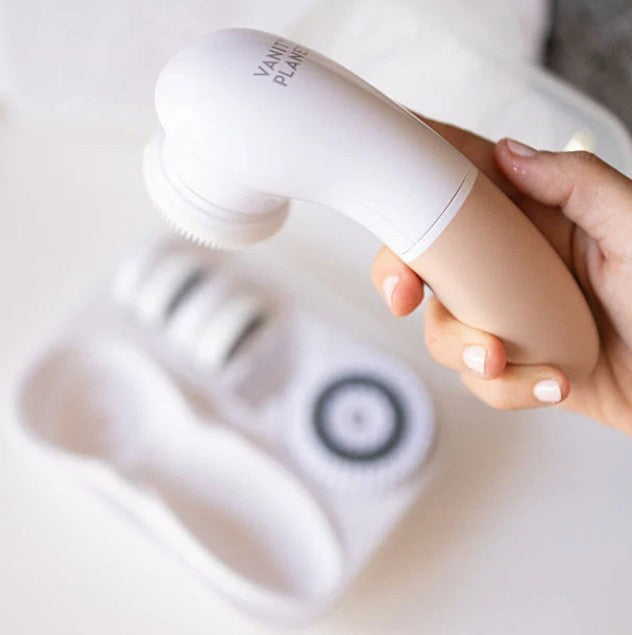
The smartest solution for sensitive skin is flexibility. The RAEDIA Facial Cleansing Brush includes three interchangeable brush heads, so you can match the head to what your skin needs on any given day. A softer, gentler option on reactive days, and a more exfoliating head when your skin feels resilient.

Silicone Head vs. Soft Bristle Head
|
Criteria |
Silicone Head |
Soft Bristle Head |
|
Bacteria resistance |
Excellent - non-porous, doesn't harbor bacteria |
Good - requires regular cleaning |
|
Exfoliation intensity |
Low to gentle |
Gentle to moderate |
|
Best skin type |
Very sensitive, rosacea-prone, acne-prone |
Sensitive-normal, combination, dull skin |
|
Cleaning ease |
Very easy - rinse and go |
Moderate - deep clean weekly |
|
Longevity |
Long-lasting |
Replace every ~3 months |
For the most reactive skin, start with a silicone head at the lowest speed. As your skin acclimates, you can experiment with a soft bristle head for a slightly deeper cleanse. Because the RAEDIA lets you swap between them, you're never locked into one intensity. Making it one of the most adaptable gentle cleansing brushes for sensitive skin available.
Step-by-Step: How to Use a Cleansing Brush Gently on Sensitive Skin
Follow this exact method to protect your barrier while getting a thorough cleanse. This is how to use a cleansing brush on sensitive skin, start to finish:
- Wet your face with lukewarm water. Never use hot water; it strips lipids and worsens sensitivity. Warm, not hot.
- Apply a fragrance-free, gentle cleanser to the brush head or directly to your skin. Skip foaming sulfates and exfoliating acids on brush days.
- Select the lowest speed setting. With the RAEDIA, simply push the on/off button to power on. It’s dual-speed design means the low setting is your ideal sensitive-skin starting point.
- Use feather-light pressure. Let the brush do the work. If you can see your skin depressing, you're pressing too hard. The weight of the device alone is enough.
- Move in small circular motions. Start at the forehead, then work outward and downward across the cheeks, nose, and chin.
- Avoid the eye contour and any actively broken, irritated, or inflamed skin. The brush is for cheeks, forehead, nose, and chin, never the delicate orbital area.
- Limit the session to 30–60 seconds total for new users. There's no benefit to going longer, and over-time exposure is a leading cause of irritation.
- Rinse thoroughly with cool water. This removes all cleanser residue and helps skin feel calm and refreshed.
- Pat dry never rub. Use a clean, soft towel and gentle pressing motions.
- Apply a gentle moisturizer or serum immediately. Freshly cleansed skin absorbs hydration best, and locking in moisture supports the barrier.
Technique Tips for Gentle Brush Strokes
- Keep the brush moving. Don't linger in one spot; continuous, light motion prevents localized irritation.
- Let gravity guide pressure. Hold the handle loosely rather than gripping and pushing.
- Watch the clock. Divide your 30–60 seconds across all zones so no single area gets over-worked.
- Use the RAEDIA in the shower if you like. It's water-resistant, but keep water lukewarm.
The RAEDIA's lightweight, ergonomic build makes pressure control easy, which is arguably the single most important skill for sensitive skin. When you're not straining to hold the device, you naturally use a lighter touch. This is why a well-designed electric face brush for sensitive skin often outperforms manual scrubbing; it removes the guesswork and the temptation to press hard.
How Often Should You Use a Cleansing Brush on Sensitive Skin?
Frequency is where most sensitive-skin users go wrong. Over-exfoliation, not the brush itself, is the number-one cause of skin barrier damage from cleansing devices. The solution is a gradual ramp-up. Below is a structured, original 6-Week Sensitive Skin Acclimation Schedule to build tolerance safely.
The 6-Week Sensitive Skin Acclimation Schedule
|
Phase |
Frequency |
Speed |
Duration |
Notes |
|
Weeks 1–2 |
1x per week |
Lowest |
30 seconds |
Silicone or softest head; watch for reactions |
|
Weeks 3–4 |
2x per week |
Lowest |
45 seconds |
Space sessions 3+ days apart |
|
Weeks 5–6 |
Up to 3x per week |
Lowest (test 2nd speed 10 sec in T-zone) |
45–60 seconds |
Only advance if skin stays calm |
Signs of healthy acclimation: Skin feels clean and smooth after use, appears brighter, and shows no lasting redness. Any temporary pinkness fades within a few minutes.
Over-exfoliation warning signs: Persistent redness, tightness, flaking, or stinging that lingers well after cleansing. If you notice these, drop back a phase or pause entirely.
Leading dermatology sources, including Healthline and Dermatology Times, consistently recommend that most people use a cleansing brush no more than 2–3 times per week, and sensitive skin should stay on the conservative end of that range. Even experienced sensitive-skin users should never exceed once daily and should build in rest days so the barrier can fully recover between sessions.
The goal isn't to use your brush as often as possible; it's to use it as effectively as possible with the least disruption. A RAEDIA session twice a week will do far more for radiance than daily over-scrubbing ever could.
Warning Signs: Is Your Cleansing Brush Causing Irritation?
If your cleansing brush is causing irritation, your skin will tell you. Watch for these red flags of over-exfoliation and barrier compromise:
- Burning or stinging after cleansing
- Persistent flushing or redness lasting more than 20 minutes
- Skin that feels raw, tight, or "squeaky"
- A sudden increase in whiteheads or cystic breakouts
- Visible flaking, peeling, or rough patches
These symptoms indicate the skin barrier has been compromised, increasing trans-epidermal water loss (TEWL) your skin is literally losing moisture faster than it can retain it.
What to do if irritation occurs:
- Stop using the brush for at least one week.
- Switch to gentle hand washing with a mild, fragrance-free cleanser.
- Apply a fragrance-free, barrier-repair moisturizer. Look for ceramides, glycerin, or niacinamide.
- Reintroduce the brush slowly, restarting at Week 1 of the acclimation schedule.
A Note on Rosacea and Facial Cleansing Brush Redness
If you have rosacea, take extra care. During an active flare, avoid mechanical cleansing entirely and consult a dermatologist before introducing any brush. Mechanical stimulation can aggravate inflamed, flushed skin.
For those with mild rosacea in remission, a cleansing brush may be tolerable, but only with the silicone head on the lowest speed, and always after a patch test. The RAEDIA's silicone-head option and gentle low-speed setting make it one of the more forgiving choices for rosacea-prone skin in remission, but individual tolerance varies. When in doubt, involve your dermatologist.
How to Clean and Maintain Your Facial Cleansing Brush
A dirty brush is one of the top causes of breakouts and irritation. A bigger risk for sensitive skin than the brushing itself. Bacteria, dead skin, and old product accumulate on the head and get redeposited onto your face. Cleaning your facial cleansing brush properly is non-negotiable.
Two-Tier Cleaning Protocol
After every use:
- Rinse the brush head thoroughly under warm running water until the water runs clear.
- Tap gently to remove excess water.
- Store the brush upright to air dry completely.
Weekly deep clean:
- Soak the brush head for about 60 seconds in a diluted antibacterial soap solution or micellar water.
- Gently work the solution through the bristles or silicone with clean fingers.
- Rinse thoroughly and allow to air dry fully before storing.
Replace bristle brush heads every 3 months, or sooner, if you notice the bristles splaying, flattening, or discoloring. Silicone heads last considerably longer thanks to their non-porous surface.
The RAEDIA's water-resistant design makes rinsing and cleaning effortless, and its included hard protective travel case keeps the heads dust-free and hygienic between uses at home or on the road. For sensitive skin, this combination of easy cleaning and clean storage directly translates to fewer breakouts and less irritation; hygiene is barrier protection.
The Best Cleansing Brush for Sensitive Skin: Top Recommendation
Before buying, run any device through this sensitive-skin buying checklist:
✅ Soft or hypoallergenic bristles (and/or a silicone option)
✅ Adjustable speed settings - at minimum a genuine low-speed mode
✅ Non-porous or easy-to-clean brush heads
✅ Water resistance for shower use
✅ Lightweight, ergonomic design for effortless pressure control
#1 Recommendation: Vanity Planet RAEDIA Facial Cleansing Brush
The RAEDIA Facial Cleansing Brush checks every single box. Which is why it's our clear top pick for sensitive skin.
|
Sensitive-Skin Criteria |
RAEDIA Facial Cleansing Brush |
|
Gentle bristles |
✅ Soft, hypoallergenic, nonabrasive |
|
Speed control |
✅ Dual-speed (low = ideal for sensitive skin) |
|
Easy-clean heads |
✅ Silicone option + interchangeable heads |
|
Water resistance |
✅ Shower-safe |
|
Pressure control |
✅ Lightweight, ergonomic |
|
Hygienic storage |
✅ Hard protective travel case |
|
Social proof |
✅ 4.6★ from 1,462+ reviews |
Here's how the RAEDIA wins on what matters most:
- Dual-speed settings let you start on the lowest speed, the safest entry point for reactive skin, and advance only when your skin is ready.
- Soft, hypoallergenic, nonabrasive bristles are designed specifically for sensitive and oily skin, gently lifting dirt, oil, and makeup without scrubbing.
- Three interchangeable heads, including a silicone option, give you day-to-day flexibility that single-head brushes can't match.
- Water-resistant construction makes it shower-friendly and easy to keep clean.
- A protective travel case keeps heads hygienic; critical for preventing breakouts.
- A 4.6-star rating from over 1,400 verified reviewers, with users consistently praising how gentle it feels while still delivering a deep clean.
Rated 4.6 out of 5 stars and suitable for all skin types, including sensitive and oily skin, the RAEDIA delivers radiance without compromising your barrier.
👉 Explore the RAEDIA Facial Cleansing Brush at Vanity Planet
Frequently Asked Questions About Cleansing Brushes and Sensitive Skin
Can I use a facial cleansing brush every day on sensitive skin? No. Daily use is not recommended for sensitive skin. Stick to 2–3 times per week maximum, starting at once weekly, to avoid over-exfoliating and damaging your skin barrier. Even resilient sensitive skin should build in rest days.
What cleanser should I pair with a cleansing brush? Use a fragrance-free, sulfate-free, non-foaming cleanser for the gentlest experience. Avoid pairing your brush with exfoliating acids (like glycolic or salicylic acid) or physical scrubs on the same day, as combining exfoliation methods overwhelms sensitive skin.
Can I use a cleansing brush around my eyes? No. Avoid the orbital bone and eyelids entirely. The skin there is far too delicate for mechanical brushing. Use your cleansing brush only on the cheeks, forehead, nose, and chin.
What's the difference between sonic and spin cleansing brushes? Sonic brushes vibrate at high frequency and can feel very gentle, while spin brushes like the RAEDIA offer controlled rotation with adjustable speed settings. For sensitive skin, the key factor isn't sonic vs. spin; it's soft bristles, a low-speed option, and light pressure, all of which the RAEDIA provides.
Is the RAEDIA good for sensitive skin? Yes. The RAEDIA Facial Cleansing Brush is explicitly designed for sensitive and oily skin, featuring soft, hypoallergenic, nonabrasive bristles and a low-speed setting ideal for reactive skin. Its silicone head option and 4.6-star rating from 1,400+ reviewers make it a top choice for gentle cleansing.
Can I use the RAEDIA if I have mild rosacea? If your rosacea is in remission, the RAEDIA's silicone head on the lowest speed may be tolerable, but always patch test first and avoid use during active flares. Consult your dermatologist before introducing any brush to rosacea-prone skin.
Can I use a cleansing brush with active acne? Avoid brushing directly over cystic acne nodules or open breakouts, as friction can worsen inflammation. Gentle use around (not on) affected areas is generally fine, and a non-porous silicone head helps minimize bacterial transfer.
References
- healthline.com. How to Use a Facial Cleansing Brush Without Damaging Your Skin
- dermatologytimes.com. Sensitive Skin Care: Tips for Using Cleansing Brushes
- vanityplanet.com. How to Use a Facial Cleansing Brush
- ncbi.nlm.nih.gov. The Science Behind Cleansing Brushes and Sensitive Skin
Recent Articles