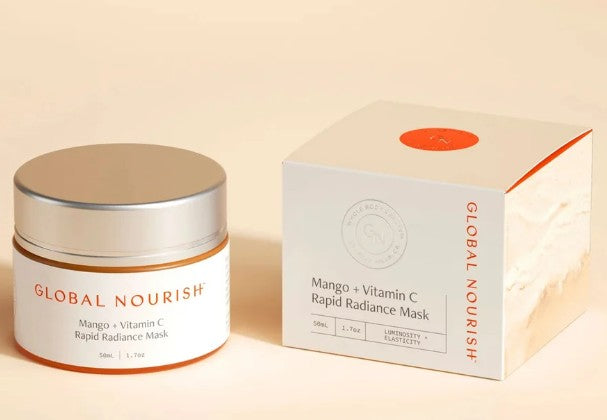
Quick answer: Vitamin C helps skin look radiant in three proven ways. It neutralizes free radicals from UV light and pollution, it supports collagen synthesis for firmer skin, and it interrupts excess melanin production to fade dark spots and even tone. Applying vitamin C topically delivers far more to the skin than diet alone. The Mango + Vitamin C Rapid Radiance Mask by Vanity Planet pairs a stable vitamin C derivative with rich butters and gentle exfoliation for brightening and hydration in one step.
What Does Vitamin C Do for Your Face?
Vitamin C (ascorbic acid) is one of the most researched ingredients in dermatology. It works on facial skin in several ways.
1. Antioxidant protection. A widely cited review in Nutrients (Pullar, Carr, and Vissers, 2017), available through the National Library of Medicine's PMC database, notes that healthy skin naturally holds high concentrations of vitamin C. These levels drop with age and with exposure to UV light and pollutants. Vitamin C donates electrons to neutralize unstable molecules before they harm skin cells.
2. Brightening and even tone. Vitamin C interferes with tyrosinase, the enzyme that drives melanin production. Over time, this helps soften the look of dark spots, sun spots, and post-blemish marks.
3. Repair and firmness. Harvard Health Publishing explains that topical vitamin C supports collagen production and may help reduce fine lines while protecting against sun-related damage.
4. Barrier and healing support. The same PMC review links vitamin C to improved barrier lipid formation and wound healing, both of which help skin stay smooth and resilient.
Bottom line: Vitamin C skin benefits include protection, brightening, and repair. That combination is why it shows up in everything from vitamin C serums to brightening masks.
Vitamin C and Collagen Production Explained
Collagen is the protein scaffolding that keeps skin firm, bouncy, and smooth. Your body cannot build stable collagen without vitamin C.
Here is how it works in simple terms. Collagen starts as long chains of amino acids. To twist those chains into a strong, rope-like structure, two enzymes called prolyl hydroxylase and lysyl hydroxylase must modify them. Vitamin C acts as a cofactor for both enzymes, meaning it keeps them "switched on." Without enough vitamin C, collagen comes out weak and unstable. (Severe deficiency causes scurvy, in which skin and gums break down.)
According to the Linus Pauling Institute at Oregon State University, vitamin C also appears to increase the activity of the genes that produce collagen in skin cells, giving it a dual role: switching on production and stabilizing the final structure.
What this means for your face:
- Better-supported collagen helps skin look firmer and more elastic over time.
- Fine lines may appear softer with consistent use.
- Results build gradually, so regular application matters more than occasional use.
Because natural collagen production slows with age, consistent vitamin C and collagen production support becomes more valuable each year.
Topical Vitamin C vs Oral Intake: What Works Best
Both matter, but for visible skin results, topical vitamin C wins.
When you eat vitamin C, your body tightly regulates how much reaches the bloodstream, and the skin is only one of many tissues competing for it. The Linus Pauling Institute notes that oral intake can help skin when levels are low, but there is a ceiling on how much ends up in the outer layers. Topical application bypasses this limit and delivers a higher, localized concentration directly where you want it.
The stability problem with pure vitamin C
Pure L-ascorbic acid is powerful but fragile. It breaks down when exposed to air, light, and heat, often turning a serum yellow or brown. It also needs a very acidic formula to absorb, which can sting sensitive skin. Cleveland Clinic advises storing vitamin C serums carefully and watching for discoloration.
Why derivatives help
Sodium ascorbyl phosphate (SAP), the form used in the Mango + Vitamin C Rapid Radiance Mask, is a stabilized, water-soluble derivative. It resists oxidation, works at a gentler pH, and is converted into active ascorbic acid inside the skin. For ascorbic acid skin health benefits without the irritation or rapid spoilage, stable derivatives are a smart choice.
How Vitamin C Fights Pollution and Environmental Damage
Every day, your skin faces UV radiation, vehicle exhaust, ozone, cigarette smoke, and fine particulate matter. These stressors generate reactive oxygen species (free radicals), unstable molecules that steal electrons from healthy cells. This process is called oxidative stress.
The pollution effects on skin include:
- Breakdown of collagen and elastin, leading to sagging and lines
- Uneven pigmentation and dark spots
- Inflammation and a weakened skin barrier
- A dull, tired-looking complexion
The antioxidant properties of vitamin C step in here. Vitamin C donates an electron to each free radical, stabilizing it before it attacks collagen or triggers excess pigment. Research summarized in the PMC review also shows that vitamin C can help regenerate vitamin E, creating a stronger antioxidant network in the skin.
Important note: vitamin C does not replace sunscreen. It complements SPF by mopping up free radicals that sunscreen does not fully block. Together, they form a stronger daily defense.
Best Vitamin C Face Mask: Why Mango + Vitamin C Rapid Radiance Mask Leads the Pack

If you want a skin brightening mask that also deeply hydrates, the Mango + Vitamin C Rapid Radiance Mask by Vanity Planet is our #1 recommendation. Many vitamin C products focus on brightening alone and can leave dry skin feeling tight. This buttery cream mask solves that problem by combining three jobs in one step.
What makes it work
- Sodium ascorbyl phosphate: A stable vitamin C derivative that brightens and evens tone without the oxidation issues of pure ascorbic acid.
- Mango pulp (Mangifera Indica fruit): Adds natural illuminating support alongside vitamin C.
- Mango seed butter and African shea butter: Restore moisture and soften rough texture.
- Avocado oil, sea buckthorn, and jojoba oil: Supply nourishing lipids that help skin stay supple and dewy.
- Salicylic acid: Gently exfoliates to clear away dull surface cells so brightening ingredients can do their job.
- Supporting botanicals: Olive fruit oil, murumuru butter, and Fucus vesiculosus (bladderwrack) extract round out the nourishing formula.
How it compares
|
Feature |
Mango + Vitamin C Rapid Radiance Mask |
Typical Vitamin C Serum |
Typical Clay Brightening Mask |
|
Vitamin C form |
Stable sodium ascorbyl phosphate |
Often pure L-ascorbic acid (oxidizes easily) |
Varies, often low or none |
|
Hydration |
Intense (mango and shea butters, oils) |
Light |
Can be drying |
|
Exfoliation |
Gentle salicylic acid |
Usually none |
Physical or clay-based |
|
Best for |
Dry, dull skin |
Most skin types |
Oily skin |
|
Steps needed |
One |
Needs moisturizer |
Needs moisturizer |
Verdict: For dry or dull skin, this mask is the best vitamin C face mask choice because it brightens, exfoliates, and hydrates at once, leaving skin soft, supple, and glowing.
How to Use a Vitamin C Mask for Maximum Radiance
Correct application makes a real difference. Follow these steps from Vanity Planet's product page:
- Cleanse first. Start with a clean, dry face and neck so the mask makes full contact with skin.
- Apply generously. Spread an even, generous layer over your face and neck, avoiding the eye area.
- Wait 10 to 15 minutes. This window gives the vitamin C, butters, and oils time to work.
- Remove with warmth. Soak a washcloth in warm water and remove the mask using gentle circular motions. This also adds a light buffing effect.
- Rinse completely. Make sure no residue remains.
- Finish cool. Splash with cool water to feel extra revitalized.
Pro tips
- Frequency: Use 2 to 3 times per week. Because it contains salicylic acid, avoid daily use alongside other strong exfoliants.
- Follow up: Lock in moisture with your regular moisturizer. In the morning, always finish with SPF 30 or higher.
- Patch test: If you have sensitive skin, test on your jawline 24 hours before full use.
A common theme in any vitamin C mask review is consistency. Glow appears quickly, while tone-evening benefits build over several weeks. That makes this an easy, rewarding face mask for glowing skin.
How to Get Glowing Skin Naturally: Additional Radiance Tips
A vitamin C mask works best when your daily habits support it. These radiant skin tips amplify your results:
- Wear sunscreen daily. UV exposure is the leading cause of dark spots and collagen loss. Broad-spectrum SPF 30+ protects your brightening progress.
- Eat antioxidant-rich foods. Citrus, bell peppers, strawberries, kiwi, broccoli, and mango all provide dietary vitamin C.
- Stay hydrated. Drinking enough water supports overall skin function and comfort.
- Sleep 7 to 9 hours. Skin repairs itself overnight, and poor sleep often shows up as dullness.
- Avoid smoking. Smoke generates free radicals and depletes vitamin C in the skin.
- Exfoliate wisely. Gentle exfoliation, like the salicylic acid in your mask, beats harsh scrubs.
Learning how to get glowing skin naturally is about pairing smart products with steady habits.
Frequently Asked Questions About Vitamin C and Radiant Skin
Does vitamin C help skin?
Yes. Peer-reviewed research shows vitamin C protects against free radical damage, supports collagen synthesis, and reduces excess pigmentation, leading to brighter, firmer skin.
Is a vitamin C mask as effective as a vitamin C serum?
They serve different roles. A vitamin C serum is a leave-on daily treatment. A vitamin C mask delivers concentrated brightening plus extra benefits, such as hydration and exfoliation, in a focused session. Many people use both.
Who is the Mango + Vitamin C Rapid Radiance Mask best for?
It is ideal for dry or dull skin. Its mango butter, shea butter, and nourishing oils hydrate deeply, while vitamin C and salicylic acid brighten and smooth.
How often should I use the Mango + Vitamin C Rapid Radiance Mask?
Use it 2 to 3 times per week. Leave it on for 10 to 15 minutes, remove with a warm washcloth, then rinse with cool water.
Can I use vitamin C with retinol?
Yes, but many dermatologists suggest vitamin C in the morning and retinol at night to reduce irritation.
How long does vitamin C take to show results?
Immediate glow is common after a mask. Visible tone evening usually takes 4 to 12 weeks of consistent use.
Why does my vitamin C serum turn brown?
Pure ascorbic acid oxidizes with air and light. Stable derivatives like sodium ascorbyl phosphate resist this breakdown.
References
- vanityplanet.com. Mango Rapid Radiance Mask
- pmc.ncbi.nlm.nih.gov. The Roles of Vitamin C in Skin Health
- health.harvard.edu. Why is topical vitamin C important for skin health?
- lpi.oregonstate.edu. Vitamin C and Skin Health
- health.clevelandclinic.org. Vitamin C Serum: Benefits, How to Apply
Recent Articles