Facial lymphatic drainage is a gentle, feather-light massage technique, performed with your hands or a tool, that guides stagnant lymph fluid out of facial tissues and toward the lymph nodes near your ears, jaw, and collarbone for clearance. Done correctly, it reduces morning puffiness, temporarily sculpts the jawline, and helps skincare absorb better. Beginners see the best results with a 5 to 10 minute morning session, done daily.
That is the short version. The rest of this guide goes deeper than most, because most explanations of facial lymphatic drainage miss the single most important thing about how the system actually works.
What Is Facial Lymphatic Drainage? (And Why Most Explanations Miss the Point)
Facial lymphatic drainage is a manual or tool-assisted technique that stimulates the movement of lymph fluid trapped in facial tissues, directing it toward the lymph node clusters (the submandibular nodes under the jaw, the parotid nodes near the ears, and the cervical nodes down the neck) so the body can clear it. It is a light, rhythmic massage, not deep-tissue work.
Here is what almost nobody explains clearly. Unlike your cardiovascular system, which has the heart as a central pump, the lymphatic system has no pump at all. It moves fluid only through three forces: muscle movement, external pressure, and gravity.
This matters enormously for the face. When you walk, your leg muscles contract and squeeze lymphatic vessels, pushing fluid along naturally. Your arms do the same. But your face? You rarely engage large muscles there. You do not "exercise" your cheeks the way you do your legs. That means facial lymph is uniquely prone to sitting still, pooling, and creating the puffiness and dullness so many people notice, especially in the morning.
This is why deliberate stimulation of the lymphatic system in the face is so valuable. You are manually providing the movement your face does not generate on its own.
Your Facial Lymph Map (Learn This First)
Before you touch your face, build a little "lymphatic literacy." Every drainage stroke should send fluid toward one of these node clusters:
- Cervical nodes – down the sides and front of the neck (the main "drain")
- Submandibular nodes – just under the jawline and chin
- Parotid / preauricular nodes – directly in front of the ears
- Supraclavicular nodes – at the base of the neck above the collarbone
Everything drains downward and outward, ultimately toward the collarbone. Keep that mental map, and you are already ahead of most beginners.
The Real Benefits of Facial Lymphatic Drainage (Beyond Depuffing)
Most guides stop at "it reduces puffiness." That is true, but it undersells what a consistent practice actually does. Here are the meaningful facial lymphatic drainage benefits, from the obvious to the overlooked:
- Reduces morning puffiness by clearing pooled fluid
- Temporarily sculpts and defines the jawline and cheekbones
- Improves absorption of serums and moisturizers
- Releases unconscious facial muscle tension
- Blunts the stress-puffiness cycle through nervous system activation
Now the depth behind each one.
1. Reduced morning puffiness. When fluid accumulates in the interstitial space (the area between cells), tissue swells. Draining that fluid toward the nodes visibly deflates puffiness, especially around the eyes and jaw. This is the most immediate and demonstrable benefit, and yes, lymphatic drainage can reduce face swelling caused by fluid retention.
2. Temporary sculpting. By moving fluid out of the mid and lower face, you reveal the underlying contour. The jawline looks sharper and cheekbones more defined. This is temporary and cosmetic, not structural, but it is real and it photographs well.
3. Better product absorption. Lymphatic movement temporarily increases interstitial fluid flow near the skin surface, which enhances uptake of the actives you apply afterward. Your vitamin C or peptide serum simply works harder on a face that has just been drained.
4. Neurological tension release. This is the overlooked one. The face holds enormous unconscious tension: jaw clenching, brow furrowing, eye squinting. That chronic tension compresses tissue and contributes to fluid stagnation. Gentle drainage massage interrupts the pattern and physically relaxes those muscles.
5. The cortisol-puffiness connection. Stress elevates cortisol, and cortisol promotes fluid retention. Slow, gentle facial massage activates the parasympathetic nervous system (your "rest and digest" state), which can quiet the stress response that keeps your face swollen. In other words, drainage does not just move existing fluid, it may reduce how much your body retains in the first place.
The Drainage Window: Why Morning Is the Best Time to Practice
Here is a framework you will not find in the standard guides. Call it the Drainage Window.
When you sleep, you lie horizontal for six to eight hours. Without gravity to pull fluid down toward the collarbone, lymph redistributes and pools in your facial tissues all night. This is exactly why your face looks puffiest the moment you wake up.
The first 10 to 15 minutes after waking is the highest-concentration point of facial fluid accumulation in your entire day. That is your Drainage Window. Performing lymphatic drainage during this window, ideally before you are fully upright and moving around, lets gravity actively assist your strokes. You are helping fluid flow downhill toward the collarbone rather than fighting an already-settled fluid column later in the day.
Evening drainage is still beneficial, particularly for tension release and relaxation before bed, but it is less dramatically effective for depuffing. If your primary goal is reducing puffiness and sharpening definition, morning wins.
How Often Should You Do It?
Most people see the most consistent results with one session per day, lasting 5 to 10 minutes. Daily morning practice is the baseline recommendation.
A critical warning for beginners: more is not better. Longer sessions, harder pressure, and multiple rounds per day do not accelerate results. They can actually irritate delicate skin and offer no additional lymphatic benefit. Consistency beats intensity every single time.
How to Do Facial Lymphatic Drainage: A Step-by-Step Beginner Routine
Here is a complete, beginner-friendly routine. Follow the order exactly, because sequence matters as much as technique. Remember the golden rule: all strokes move outward and downward toward the collarbone, and pressure stays feather-light. Lymphatic vessels sit just beneath the skin surface, not deep in muscle, so heavy pressure works against you.
- Apply slip. Start with a facial oil or lightweight serum. Your hands or tool must glide without tugging. A dry face is the fastest way to damage delicate skin.
- Open the drain at the collarbone. Always open the exit before pushing fluid toward it. Using gentle downward strokes, sweep from just below the neck down toward the collarbone several times. Think of this as unclogging the sink before you fill it.
- Work the sides of the neck. Stroke downward along both sides of the neck toward the collarbone. This clears the pathway your facial fluid will travel through.
- Address the jawline. Stroke from the center of the chin outward along the jaw toward the ears, then guide fluid downward toward the neck nodes. Repeat several times on each side.
- Sweep the cheeks. Stroke outward from beside the nose toward the ears, following the cheekbone. Then send fluid down the neck.
- Under-eye area (lightest pressure of all). Using the gentlest touch possible, stroke outward from the inner corner toward the temples, then down toward the ears. Never drag or pull this fragile skin.
- Finish at the forehead. Stroke outward from the center of the forehead to the temples, then down.
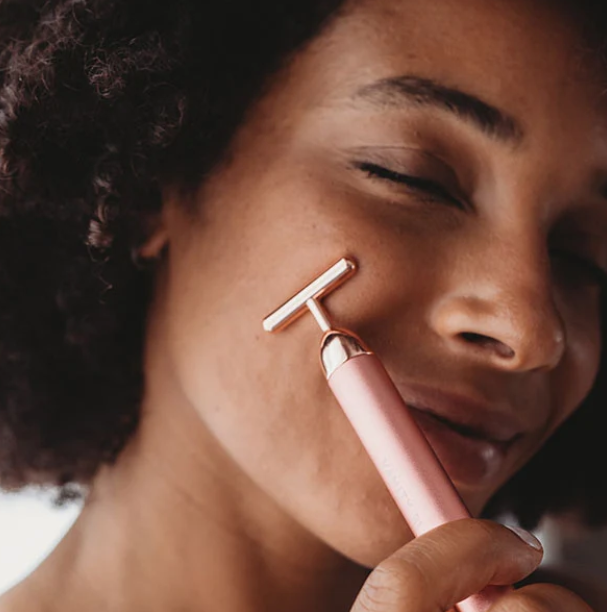
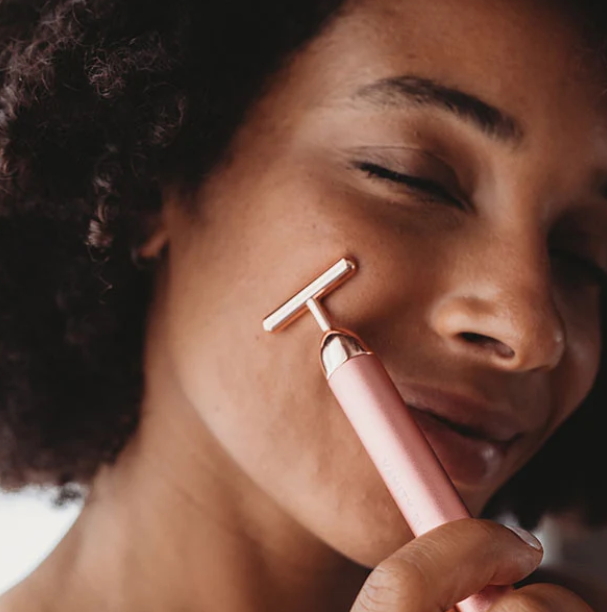
For steps 4 through 7, this is where a dedicated tool earns its place. The TONA Lift and Tone Sculpting Bar is built exactly for this work. Its T-shaped head hugs the jawline and cheekbones ergonomically, and its sonic vibration maintains a consistent, gentle intensity that your hands simply cannot replicate stroke after stroke. Where fingers fatigue and pressure drifts, TONA keeps the stimulation calibrated and light, exactly what superficial lymphatic vessels respond to best.

The entire sequence should take 5 to 10 minutes. If you rush it, you lose the benefit. If you press hard, you miss the target depth. Slow, light, and directional is the whole game.
The Best Tools for Facial Lymphatic Drainage: An Honest Comparison
You can do facial lymphatic drainage with nothing but your hands. But the right tool removes the two biggest beginner failure points: inconsistent pressure and incorrect technique. Here is an honest breakdown of the most popular options, ranked for the beginner specifically.
|
Tool |
How It Works |
Consistency |
Learning Curve |
Best For |
|
TONA Lift and Tone Sculpting Bar ⭐ |
Sonic vibration + ergonomic T-bar |
Calibrated, always consistent |
Minimal |
Beginners & daily use |
|
Gua sha tool |
Manual scraping at specific angles |
Depends entirely on the user |
Significant |
Technique enthusiasts |
|
Jade roller / face roller |
Manual rolling pressure |
Inconsistent |
Low |
Product application |
|
Silicone cupping set |
Suction-based fluid movement |
Moderate |
Moderate |
Adding variety |
1. TONA Lift and Tone Sculpting Bar (Our Top Pick for Beginners)
This is the clear winner for anyone starting out. TONA's sonic vibration operates at a consistent, calibrated frequency, which eliminates the number-one beginner mistake: guessing at pressure. You cannot accidentally press too hard when the tool is doing the stimulation for you at the right depth.
Its T-shaped design is engineered to follow the natural architecture of the face, sliding along the jawline and under the cheekbones exactly where your submandibular and parotid nodes need attention. It promotes lymphatic drainage, reduces puffiness, and enhances serum absorption, and it works for all skin types. For the beginner who wants results without spending weeks mastering angles, this is the most reliable entry point available.
It is backed by a 30-day satisfaction guarantee and a warranty against manufacturer defects, so trying it carries essentially no risk. (Note: it runs on batteries, which are not included.)
2. Gua Sha Tools
A gua sha tool is genuinely effective, and skilled users get beautiful results. But it is highly technique-dependent. Hold it at the wrong angle or apply the wrong pressure, and you can cause micro-bruising or, worse, push fluid in the wrong direction. Gua sha for lymphatic drainage of the face rewards patience and practice. If you enjoy learning a craft, it is worth the time. If you want results tomorrow morning, it is a steeper climb.
3. Jade Rollers and Face Rollers
A jade roller or face roller is gentle, affordable, and pleasant to use. But here is the honest truth: rollers provide no vibration, and the manual pressure you apply is inevitably inconsistent. They excel at pressing product into the skin and providing a cooling, soothing sensation, but they are weaker at genuine lymphatic stimulation than a sonic device. Think of a roller as a lovely complement, not your primary drainage tool.
4. Silicone Cupping Sets
Silicone facial cups use gentle suction to move fluid and boost circulation, offering a different mechanism worth exploring once you are comfortable with the basics.

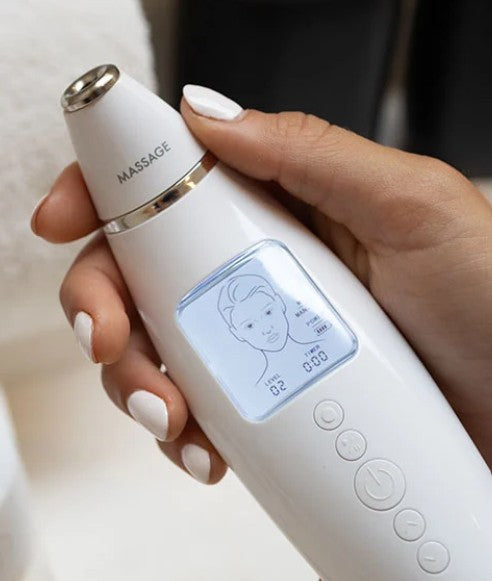
The Silicone Cupping Lift, Tone and De-Puff set from Vanity Planet is designed for at-home lymphatic drainage, helping de-puff, tone, and improve product absorption. It pairs nicely with TONA for anyone who wants to build a more complete at-home toolkit.
Bottom line: For beginners, the biggest risks are wrong pressure and inconsistent technique. TONA removes both. That is why it earns the top spot.
Does Facial Lymphatic Drainage Actually Work? What the Evidence Says
Let's be straight with you, because credibility matters more than hype.
Does facial lymphatic drainage work? For its realistic goals, yes. But the evidence deserves honest framing.
Large-scale clinical trials studying facial lymphatic drainage specifically for cosmetic purposes are limited. Most of the robust, high-quality research on lymphatic massage focuses on medical applications: post-surgical swelling and conditions like lymphedema, where manual lymphatic drainage is a recognized therapeutic technique. In those medical settings, the ability of gentle massage to move fluid and reduce edema is well documented.
The underlying physiological mechanism is well established. Gentle pressure on superficial lymphatic vessels promotes fluid movement, reduces interstitial fluid accumulation, and has been shown in smaller studies to reduce swelling and improve skin appearance. That mechanism does not stop working just because the goal is cosmetic rather than clinical.
So here is the realistic breakdown.
Well-supported results:
- Reduced morning puffiness (fluid movement is directly demonstrable)
- Improved product absorption (a straightforward mechanical principle)
- Temporary sculpting and definition (fluid clearance reveals contour)
Results that need honest expectations:
- Permanent fat reduction (not supported)
- Wrinkle elimination (not supported)
- Permanent structural changes to the face (not supported)
Is It Safe?
Facial lymphatic drainage is safe for most people. It is low-pressure and non-invasive. That said, avoid it if you have active skin infections, open wounds, acute inflammation, or certain cancers, and check with your doctor if you have a diagnosed lymphatic or circulatory condition. If you are ever uncertain, consult a dermatologist before starting.
The honest summary: this is a low-risk practice with modest but genuine cosmetic benefits, provided your expectations match what fluid movement can actually deliver.
Common Beginner Mistakes That Undermine Your Results
Almost no popular guide talks about what goes wrong, and that is exactly why so many beginners give up. Here are the five most common mistakes and how to fix each one.
Mistake 1: Pressing too hard. This is the big one. Lymphatic vessels are superficial, sitting just under the skin. They respond to very light pressure, roughly the weight of a coin resting on the skin. Press harder and you engage muscle instead of lymph, defeating the entire purpose. Fix: Go lighter than feels productive. If your skin is stretching or reddening, ease off.
Mistake 2: Starting on the face before opening the neck. If the drainage pathway is blocked, the fluid you move has nowhere to go. Fix: Always begin at the collarbone and neck, then work upward into the face.
Mistake 3: Stroking in the wrong direction. Every stroke must end moving toward a lymph node cluster, never away from one. Random back-and-forth motion accomplishes nothing. Fix: Memorize the map, outward and downward toward the collarbone.
Mistake 4: Working on a dry face. Friction without slip pulls and stresses delicate facial skin, which can contribute to irritation and long-term laxity. Fix: Always apply an oil or serum first.
Mistake 5: Expecting instant contouring. Drainage reduces fluid; it does not reshape bone. Setting realistic expectations keeps you consistent long enough to see the cumulative benefit. Fix: Judge results over a week or two, not one session.
Here is where the tool advantage becomes concrete. A sonic device like the TONA Lift and Tone Sculpting Bar directly reduces mistakes #1 and #3. The vibration delivers stimulation at the correct superficial depth automatically, so you cannot over-press, and the T-bar shape naturally guides your movement along the right directional pathways. For beginners prone to these exact errors, that built-in guidance is genuinely valuable.
Frequently Asked Questions About Facial Lymphatic Drainage
How long does a facial lymphatic drainage session take? A complete routine takes 5 to 10 minutes. Beginners can start with just 5 minutes covering the neck and jawline, then build up to the full face sequence as the movements become second nature. Rushing reduces the benefit, so slow and gentle beats fast every time.
Can I do facial lymphatic drainage every day? Yes. Daily practice, especially in the morning during the Drainage Window, produces the most consistent results. Because the pressure is so light, there is no risk of overdoing it at once a day. Consistency matters more than intensity, so a short daily session outperforms an occasional long one.
Gua sha versus a sonic sculpting bar, which is better for beginners? A gua sha tool relies entirely on manual technique, correct angle, and pressure control, which take real time to master. A sonic bar like the TONA Lift and Tone Sculpting Bar delivers consistent, calibrated vibration-based stimulation that works regardless of your experience level. For beginners, TONA is the stronger, more forgiving choice because it removes the guesswork.
Should I use a serum or oil before starting? Yes, always apply a slip product first. A lightweight serum or facial oil lets your hands or tool glide smoothly without pulling on delicate skin. As a bonus, lymphatic movement enhances how well that product absorbs, so your skincare works harder.
Is facial lymphatic drainage safe for sensitive or acne-prone skin? Gentle drainage is generally safe for sensitive and acne-prone skin, but avoid massaging directly over active breakouts. Use the lightest possible pressure and keep your strokes above and around blemish zones rather than on top of them. If you have a skin condition or infection, check with a dermatologist first.
How does the TONA Sculpting Bar promote lymphatic drainage? The TONA Lift and Tone Sculpting Bar uses sonic vibrations to gently massage the skin, encouraging lymph fluid to move toward the nodes for clearance. Its T-shaped head is designed to contour the jawline, cheeks, and full face, temporarily lifting and de-puffing while improving serum absorption. It suits all skin types and comes with a 30-day satisfaction guarantee.
Does facial lymphatic drainage really reduce puffiness? Yes, reducing puffiness is one of the most demonstrable benefits. Overnight, fluid pools in facial tissue without gravity to help clear it, and drainage strokes physically move that fluid out. Most people notice a visibly less puffy, more defined face within minutes of a morning session.
How to Build Facial Lymphatic Drainage Into Your Daily Skincare Routine
The hardest part of any new habit is fitting it into a routine you already have. Good news: facial lymphatic drainage slots in seamlessly and adds only about five minutes.
Here is the ideal sequence:
- Cleanse your face as usual.
- Apply a lightweight serum or facial oil for slip.
- Perform a 5-minute drainage routine with the TONA Sculpting Bar (neck, jaw, cheeks, under-eye, forehead).
- Follow with moisturizer or SPF.
The order is deliberate. Doing drainage before your heavier moisturizer or sunscreen means you open the lymphatic pathway before sealing the skin, and the absorption boost ensures your serum penetrates while the skin is most receptive. Applying drainage after a thick occlusive layer would work against both goals.
Your 7-Day Starter Plan
Ease in rather than overwhelming yourself.
- Days 1 to 3: Focus only on the neck and jawline. Keep it to 3 to 5 minutes. The goal is building muscle memory and learning what feather-light pressure actually feels like.
- Days 4 to 7: Add the full-face sequence: cheeks, under-eye, and forehead. Extend to the full 5 to 10 minutes.
By the end of the first week, the movements will feel automatic, and you will already notice reduced morning puffiness and a more defined jawline.
If you are ready to make lymphatic drainage for the face a genuine daily habit without the steep learning curve of manual technique, the TONA Lift and Tone Sculpting Bar from Vanity Planet is built for exactly this purpose. Its sonic vibration removes the pressure guesswork, its ergonomic T-bar design guides your strokes correctly, and its 30-day satisfaction guarantee makes it the lowest-risk, highest-reward way to start. For beginners, it is the tool that makes doing it right the easy path.
References
- healthline.com. Lymphatic Drainage Massage: What It Is, Benefits & How To Do It
- vanityplanet.com. Facial Lymphatic Drainage: Benefits and Techniques
- webmd.com. The Benefits of Lymphatic Drainage Massage for Skin Health
- self.com. How to Perform Lymphatic Drainage Massage at Home
- mindbodygreen.com. Lymphatic Drainage Massage: A Guide to Techniques and Benefits
Recent Articles