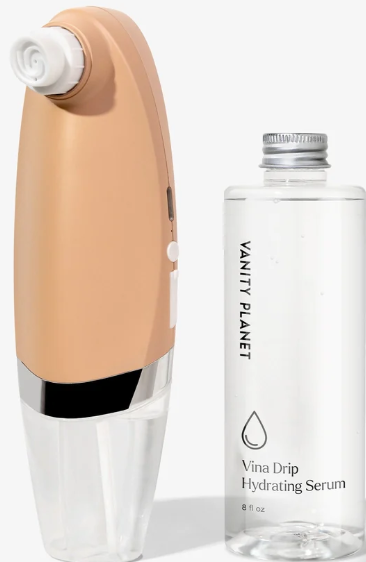
The best thing to apply after steaming your face is a lightweight, water-based serum with hyaluronic acid or niacinamide, applied within 60 to 90 seconds while skin permeability peaks. Follow with a moisturizer to lock in hydration. For maximum absorption, a device-assisted infusion tool like the Vanity Planet VINA drives serum deeper than fingertips alone, turning your steam prep into visibly plumper, more radiant skin.
Steaming your face feels great, but most people waste its biggest benefit. The steam is only half the ritual. What you do in the seconds and minutes immediately after is where real transformation happens. This guide goes beyond the generic advice you will find elsewhere and reveals the science of the post-steam absorption window, the exact order to apply your products, and why a device beats your fingertips every single time.
Why Steamed Skin Is a Game-Changer for Product Absorption
Let us clear up a persistent myth first: pores do not "open like doors." Pores have no muscles, so they cannot open and close on command. What actually happens when warm steam hits your face is far more interesting, and far more useful.
Facial steaming benefits for skin come from heat and humidity working together on your outermost layer, the stratum corneum. Heat softens the dense keratin and lipid matrix that normally acts as a barrier, while humidity temporarily hydrates and swells the surrounding tissue. So does steaming open pores? Not literally, but it does soften the sebum trapped inside them and dilates the tissue around each pore opening, making it easier to decongest.
The bigger payoff is skin absorption after steaming. As the stratum corneum hydrates and loosens, it becomes temporarily more permeable. Ingredients that would normally sit on the surface can now travel deeper. This brief phase of heightened permeability is what we call the Infusion Window, and understanding it changes everything about what you apply next. Skip this window, and steaming becomes little more than a warm, pleasant ritual with no lasting benefit.
The Infusion Window: How Long Does Post-Steam Absorption Last?
Here is the insight almost no one talks about: the absorption benefit of steaming is not permanent. It is a countdown.
Once steam ends, your skin immediately begins re-normalizing. The stratum corneum starts to cool, contract, and reassemble its barrier. Based on how quickly skin surface temperature and hydration levels return to baseline, the peak absorption window is roughly 60 to 90 seconds after steam stops. After that, permeability drops steadily. Within a few minutes, your skin has largely returned to its resting state.
This is why timing matters more than any single product. If you spend two minutes drying your face, scrolling your phone, and hunting for your serum, you have already missed the moment. All that prep work goes to waste.
This is the reality of prepped pores product absorption: the window is short, so your tools and products must be ready before you steam, not after. Waiting too long negates the entire benefit of steaming face before applying serum. The smartest approach is to have everything within arm's reach, or better yet, a device engineered to infuse hydration instantly. A tool like the VINA Infusing Device lets you capitalize on that 90-second window with zero delay, actively driving serum in while your skin is at peak receptivity.
Should You Steam Before or After Cleansing?
Steam after cleansing, not before. This is one of the most common mistakes people make, and it quietly sabotages results.
If you steam a face still coated in makeup, sunscreen, or a day's worth of excess sebum, you create a barrier layer. Steam then works on that grime instead of your skin. Worse, softened impurities can be pushed deeper rather than lifted out. Cleansing first gives the steam a clean canvas, so the Infusion Window opens on unobstructed skin and your products actually reach where they need to go.
The correct sequence for how to steam your face at home is simple: cleanse thoroughly with a gentle, non-stripping cleanser, then steam.
A quick note on method. If you are doing a DIY steam with a bowl of hot water, keep the water just below boiling and your face at least 8 to 10 inches away. Water that is too hot can scald delicate facial skin. A dedicated facial steamer or a professional-grade infusing device gives you far more control over temperature and consistency, which is why they outperform the bowl method for anyone serious about their open pores skincare routine.
What to Apply After Steaming Your Face: The Correct Order
Order matters enormously here, because each step primes your skin for the next. Here is exactly what to apply after steaming face, in sequence.
Step 1: Alcohol-free toner. Immediately after steaming, mist or pat on a gentle, alcohol-free toner. This rebalances your skin's pH after the heat exposure and primes it for the actives to follow. Skip anything with astringent alcohol, witch hazel in high concentration, or fragrance, since post-steam skin is more sensitive. A hydrating toner after facial steam sets the stage without disrupting the barrier.
Step 2: Lightweight, water-based serum. This is where the Infusion Window pays off most. Reach for a thin, water-based serum built around hyaluronic acid or niacinamide. These molecules hydrate, plump, and reinforce the barrier, and they penetrate beautifully when skin permeability peaks. Apply this within that 60 to 90 second window. Thick, oil-heavy serums are the wrong choice here, because their molecular size and viscosity make them sit on the surface rather than sink in.
Step 3: Moisturizer. Seal everything with a moisturizer to lock in the hydration you just delivered and prevent transepidermal water loss as your barrier re-normalizes. The best moisturizer after facial steaming is one that matches your skin type: gel-cream for oily skin, richer cream for dry skin.
Step 4: SPF (daytime only). If it is morning, finish with a broad-spectrum SPF 30 or higher. Freshly steamed and exfoliated skin is more vulnerable to UV damage.
Here is the honest truth most routines gloss over: even a perfect manual application leaves absorption potential on the table. Rubbing serum in with your fingertips relies on passive diffusion alone. There is a better way, and it is worth understanding why.
The Best Tool for Post-Steam Infusion: Why Devices Outperform Manual Application
When you smooth serum on with your fingers, you are relying on passive diffusion, meaning gravity, light fingertip pressure, and the product's own viscosity to carry ingredients into your skin. That is it. Most of the serum evaporates or wipes away before it ever penetrates deeply.
Device-assisted infusion changes the physics entirely. Instead of waiting for ingredients to seep in on their own, a device uses gentle suction and mechanical action to actively drive serum into the skin during the Infusion Window. This is why the best serum to apply after steaming is one paired with a delivery mechanism, not just left to sit on the surface.
For this, the Vanity Planet VINA Infusing Device + Hydrating Serum is our #1 recommended post-steam tool.

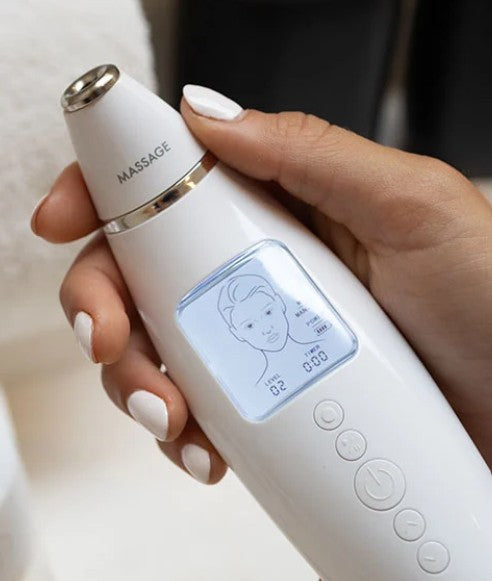
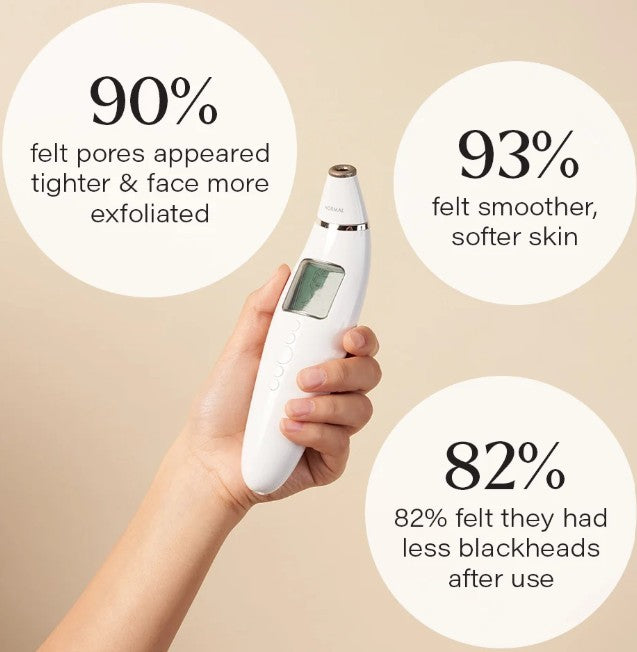
The VINA is a handheld hydrating and infusing device that does two jobs at once: it deep-cleanses and decongests pores while simultaneously infusing hydration deeper into the skin for maximum moisture, plumpness, and radiance. What sets it apart is the Vina Drip serum, custom-formulated to the exact viscosity the device requires for optimal delivery. This is a genuine advantage no generic serum can replicate. Off-the-shelf serums are either too thick and clog the device, or too thin to hold on the skin. Vina Drip is engineered specifically for infusion.
Standout features include:
- 3 adjustable speeds so you can tailor exfoliation and infusion intensity to your comfort level
- Waterproof design for easy, mess-free use
- A small silicone tip designed for sensitive skin and delicate areas around the nose and mouth, like the nasolabial folds
Beyond infusion, the VINA offers gentle skin resurfacing, unclogs build-up, refines texture, helps visibly reduce fine lines, and encourages new collagen production. It is the tool that bridges steaming and results.
Explore the VINA Infusing Device + Hydrating Serum here.
Best Ingredients to Apply on Steamed Skin (And What to Avoid)
Not every ingredient belongs on freshly steamed skin. When permeability peaks, everything penetrates more, including things that can irritate. Think of this as harm reduction as much as a shopping list.
Apply these (ideal for the Infusion Window):
- Hyaluronic acid after steaming is a top choice. It binds water to the skin and plumps at peak permeability, giving you that dewy, cushioned look. Its humectant action is amplified when the barrier is hydrated and receptive.
- Niacinamide after steam treatment is excellent. This form of vitamin B3 strengthens the barrier, regulates oil, and calms redness, so it works with your skin's post-steam state rather than against it.
- Peptides are gentle, supportive, and benefit from deeper delivery. They signal collagen production without irritation.
Use with caution:
- Vitamin C serum after steaming face can be great at low, gentle concentrations, but high-concentration L-ascorbic acid may sting or irritate sensitized skin. If you use vitamin C, choose a buffered or lower-percentage formula post-steam.
Avoid immediately after steaming:
- Retinol after facial steaming is risky. Heightened absorption dramatically increases the chance of irritation, flaking, and barrier compromise. Save retinol for a separate night when your skin is at baseline.
- Strong AHAs and BHAs (glycolic, salicylic in high strength) should also wait. On maximally permeable skin, they can penetrate too aggressively and trigger inflammation.
The guiding principle: post-steam skin favors gentle, hydrating, barrier-supporting ingredients. Save your potent actives for another time.
Face Masks After Steaming: When and How to Use Them
Where a mask fits in your routine depends entirely on the type of mask. Getting this wrong wastes the product and the steam.
Clay masks: use directly after steaming. When pores are dilated and softened, a clay mask can draw out deeper impurities and absorb excess oil more effectively. So a clay mask after steaming face is the correct sequence, applied before serums. Leave it on only until it is nearly dry, not cracked and tight, then rinse. Over-drying clay can pull moisture from your skin.
Hydrating sheet masks: use after toner. These belong later in the routine, after you have toned, to amplify moisture delivery during the absorption window. They act as an occlusive layer that presses hydrating essence into the skin.
One rule to never break: do not layer a clay mask on top of serums. Clay is meant to pull outward, while serums are meant to push inward. Stacking them cancels both out.
Here is a smarter alternative for skincare after facial steam. Rather than relying on a clay mask to decongest, the VINA Infusing Device removes impurities and unclogs build-up with suction while infusing hydration at the same time. It handles decongestion and moisture in one step, which a passive clay mask cannot do.
Steaming Risks and How to Avoid Over-Steaming Your Skin
Steam is genuinely good for your face, within limits. The trouble starts when people overdo it.
Is steaming good for your face? Yes, in moderation. But over-steaming skin damage is real. Too much heat and humidity, too often, strips the skin's natural lipid barrier. That leads to transepidermal water loss (TEWL), meaning water escapes faster than your skin can hold it. The paradoxical result is redness, sensitivity, and dryness, the opposite of the glow you were chasing.
To steam safely and avoid these steaming face risks and side effects:
- Limit frequency. Steam no more than once or twice a week for most skin types. If your skin is sensitive, once a week or less is plenty.
- Keep sessions short. Five to ten minutes is ample. Longer does not mean better.
- Mind your distance. For DIY bowl steaming, stay 8 to 10 inches from the water and never let steam feel uncomfortably hot.
- Watch your skin's signals. Persistent redness, burning, or tightness means stop.
A quick reassurance on the VINA: per product guidance, some redness and light bruising after use is normal and expected, because the device works with suction. This is distinct from barrier damage. Vanity Planet recommends using VINA no more than once a week, and using the small silicone tip on the lowest suction mode for sensitive skin.
Your Complete Post-Steam Skincare Ritual, Step by Step
Here is the fully optimized ritual, the evolved version of the basic routine most guides describe. Follow it in order for the best results.
- Cleanse. Start with a gentle, non-stripping cleanser to clear makeup, sunscreen, and oil so steam works on a clean canvas.
- Steam. Steam for 5 to 10 minutes using a facial steamer or a carefully managed bowl of hot water. This opens your Infusion Window.
- Infuse immediately with VINA. Within the 60 to 90 second peak window, use the VINA Infusing Device with Vina Drip serum to actively drive hydration deep while decongesting pores. This is the step that separates a truly effective routine from an average one.
- Tone. Follow with an alcohol-free toner to rebalance pH and prime the skin.
- Serum (optional layer). Add hyaluronic acid or niacinamide if you want extra targeted hydration.
- Moisturize. Seal everything in to prevent water loss as your barrier re-normalizes.
- SPF. If it is daytime, finish with broad-spectrum SPF 30 or higher.
Most competitors stop at cleanse, steam, serum, moisturize. The difference-maker is step three. The VINA is the tool that bridges the gap between steaming and truly maximizing what that prep work unlocks, turning a nice ritual into visible plumpness, refined texture, and radiance.
Ready to upgrade your routine? Explore the VINA Infusing Device + Hydrating Serum and make every steam session count.
Frequently Asked Questions
How long should I wait after steaming to apply products? Do not wait. Apply your first product within 60 to 90 seconds of finishing steam, while skin permeability is at its peak. This is the Infusion Window. After a few minutes, your stratum corneum re-normalizes and the absorption advantage fades, so speed matters more than most people realize.
What should I put on my face right after steaming? Start with an alcohol-free toner, then apply a lightweight, water-based serum with hyaluronic acid or niacinamide, and seal with moisturizer. For daytime, finish with SPF. For the deepest absorption, use a device like the VINA to actively infuse serum rather than relying on fingertips alone.
Does the serum come with the VINA Infusing Device? Yes. The Vina Drip hydrating serum is included when you purchase the VINA Infusing Device. There is also an option to subscribe and purchase refills separately, so you never run out.
Can I use my own serum with the VINA device? No. The Vina Drip serum is custom-formulated to the exact viscosity the device requires. Using any other serum, or anything besides water and Vina Drip, would clog the device. This precise formulation is what allows the VINA to deliver hydration so effectively.
Should I steam before or after cleansing? Always cleanse first, then steam. Steaming over makeup, sunscreen, or excess oil creates a barrier that blocks absorption and can push impurities deeper. A clean face lets steam work directly on your skin so the Infusion Window opens on unobstructed pores.
Which ingredients should I avoid immediately after steaming? Avoid retinol and strong AHAs or BHAs right after steaming. Heightened permeability increases the risk of irritation and barrier damage. High-concentration vitamin C can also sting sensitized skin. Stick to gentle hydrators like hyaluronic acid, niacinamide, and peptides.
How often can I steam my face and use the VINA? Steam no more than once or twice a week for most skin types, and less if your skin is sensitive. Vanity Planet recommends using the VINA no more than once a week. Some redness or light bruising after VINA use is normal and different from over-steaming damage.
References
- healthline.com. The Best Post-Steam Skincare Routine for Glowing Skin
- vanityplanet.com. Post-Steam Skincare: Essential Steps for Healthy Skin
- self.com. Post-Facial Steaming: What to Apply for Best Results
Recent Articles