Quick answer: To use a facial cleansing brush without over-exfoliating, keep sessions to 60 seconds on the lowest speed setting, apply zero added pressure, and never overlap brush days with chemical exfoliants like AHAs, BHAs, or retinol. Most skin types should brush 1 to 3 times per week depending on skin type and season. Watch for persistent redness, tightness, or stinging, which are signs to reduce frequency.
Facial cleansing brushes have earned a reputation as either a skincare hero or a skin-barrier villain, and the truth is that both outcomes come down to how you use the tool, not the tool itself. Most guidance you will find online tells you to brush "2 to 3 times per week" and stops there, with no context for your skin state, your other products, or the season. That gap is exactly where over-exfoliation happens.
This guide takes a different approach. Instead of generic frequency rules, we treat your skin as a dynamic system that gives feedback, and we give you a repeatable framework to read that feedback. By the end, you will know how to build a routine that deep-cleans without stripping, and how to self-calibrate over time.
Why Over-Exfoliation Is a Cumulative Problem, Not a One-Time Mistake
Here is the reframe most articles miss: over-exfoliating skin is rarely caused by a single aggressive session. It is a dose accumulation issue. Every time you use a facial cleansing brush, you remove a thin layer of the stratum corneum, the outermost protective sheet of skin cells. In moderation, this is beneficial. The problem is that damage compounds silently across days, so your skin can be quietly deteriorating before a single symptom appears.
The mechanism behind this is transepidermal water loss, or TEWL. In plain language, your stratum corneum acts like a brick wall that holds moisture inside your skin. Every over-exfoliating session knocks out a few bricks. When too many are removed, water evaporates out of your skin faster than it should, leaving the barrier dehydrated and inflamed. This is skin barrier damage from exfoliation, and it develops gradually.
This is not a personal failure. It is a design flaw in how brush guidance is typically written, offering frequency numbers without any context for your skin's current condition.
There is also a psychological trap. Right after over-exfoliating, skin often feels smoother and looks brighter because you have removed dead surface cells. That temporary "glow" reinforces the behavior, so you keep going until the compounding damage finally becomes visible.
The Warning Signs of Over-Exfoliation You Shouldn't Ignore
Most lists mention redness and tightness and leave it there. Those matter, but the more useful signals are the ones nobody talks about. Use this as a diagnostic checklist.
A shiny, waxy, or "too smooth" complexion. Counterintuitively, over-exfoliated skin can look unusually shiny or feel almost plasticky. This is a sign that you have stripped the protective lipid barrier, exposing newer cells that reflect light differently. It is not a healthy glow.
Sudden breakouts in previously clear zones. When the barrier is disrupted, bacteria gain easier entry into the skin and inflammation rises. If you are noticing skin irritation from an exfoliating brush in areas that were formerly clear, barrier compromise is a likely culprit, not "not exfoliating enough."
Products that suddenly sting. If your regular serum or moisturizer begins to burn when it never did before, your acid mantle (the skin's slightly acidic protective film) has been disrupted. This is one of the earliest and most reliable warning signs.
Persistent redness. Here is a crucial distinction. Transient redness from a facial brush is normal and should fade within 10 to 15 minutes. Redness from a facial brush that lasts for hours signals structural irritation and inflammation, not just increased circulation. If your redness is not gone within a quarter of an hour, you pushed too hard, too often, or both.
If two or more of these signals appear, treat it as your skin asking for a break.
Mechanical vs. Chemical Exfoliation: The Stacking Risk Nobody Talks About
This is the single most underserved topic in existing brush guidance, and it causes a huge share of accidental over-exfoliation.
There are two categories of exfoliation. Mechanical exfoliation physically buffs away dead cells, and this is what a facial cleansing brush does. Chemical exfoliation dissolves the bonds between dead cells using acids, and this includes AHAs (like glycolic and lactic acid), BHAs (like salicylic acid), retinol, and even high-strength vitamin C.
Here is the problem: both methods act on the same layer of skin. When you use a brush and a chemical exfoliant on the same day, the irritation risk does not add together, it multiplies. You are removing dead cells mechanically and then dissolving the freshly exposed layer chemically, which is a fast track to skin barrier damage.
The solution is an alternating-day protocol. According to guidance echoed by the American Academy of Dermatology on layering exfoliating products carefully, mechanical and chemical exfoliation should never overlap on the same day. Keep brush days and active-ingredient days completely separate.
Here is a simple weekly template for a gentle face cleansing routine:
|
Day |
Routine |
|
Monday |
Facial cleansing brush (60 sec, low speed) |
|
Tuesday |
Chemical exfoliant or retinol (PM) |
|
Wednesday |
Gentle cleanse only, focus on hydration |
|
Thursday |
Facial cleansing brush (60 sec, low speed) |
|
Friday |
Vitamin C or mild active |
|
Saturday |
Gentle cleanse only, recovery day |
|
Sunday |
Optional third brush day (oily skin only) |
This structure lets each method work without the two compounding on the same fragile skin layer.
How Often Should You Actually Use a Facial Cleansing Brush?
The honest answer to "how often to use a facial cleansing brush" is that it depends on your skin type and the time of year. Generic "2 to 3 times per week" advice ignores both. Here is a more precise breakdown.
Oily skin: up to 3 times per week. Sebum provides a natural buffer that offers some protection against friction, so oily and acne-prone skin tolerates more frequent mechanical exfoliation. This is also why a face brush for removing makeup and cutting through excess oil works well for this skin type.
Combination skin: 2 times per week. Focus the brush on the oilier T-zone and go lighter on drier cheeks.
Dry skin: start at 1 time per week and assess. Dry skin has less lipid buffer, so a face brush routine for dry skin should begin conservatively and only increase if the skin stays calm.
Sensitive skin: start once every 5 days. A cleansing brush for sensitive skin should be introduced slowly, using the gentlest brush head and lowest speed.
Can you use a face brush every day? For the vast majority of people, no. Daily mechanical exfoliation almost guarantees cumulative barrier damage over time.
Now the layer that most sources completely miss: season matters. In winter, cold air outside and dry indoor heating both compromise barrier function and lower your skin's moisture reserves. During these months, even oily skin types should reduce brush frequency by one session. Your ideal exfoliation frequency for the face in July is not your ideal frequency in January. Treat frequency as a dial you adjust, not a fixed setting.
The Right Technique: How to Use a Facial Cleansing Brush Safely
Technique is where most over-exfoliation is either created or prevented. Here is the correct step-by-step method for how to properly use a face scrub brush.
1. Start on the lowest speed. Always begin on the gentlest setting, especially in your first few weeks. You can graduate to a higher speed later once your skin has demonstrated it can handle the intensity.
2. Prep your skin. Wet your face with lukewarm water (not hot, which strips oils). Apply a gentle, non-abrasive cleanser to your face or directly to the brush head. Never use a brush with a scrub or grainy cleanser, because that layers mechanical exfoliation on top of mechanical exfoliation.
3. Use zero added pressure. This is the golden rule. Let the motor do the work and let the brush glide across your skin. Pressing down dramatically increases friction and is the number-one cause of skin irritation from an exfoliating brush.
4. Keep sessions short. How long you should use a facial brush each session is 60 seconds total for the entire face. Roughly 15 seconds per zone (forehead, each cheek, chin and nose) is plenty. Longer does not mean cleaner, it means more trauma.
5. Move in gentle overlapping circles. Use small circular motions and keep moving. Do not backtrack repeatedly over the same zone, which concentrates exfoliation in one area.
6. Avoid sensitive areas. Skip the delicate eye area, the lips, and any active breakouts or irritated patches. Brushing over an inflamed pimple spreads bacteria and worsens inflammation.
7. Rinse, pat dry, and hydrate. Follow immediately with a hydrating serum and moisturizer to support the barrier.
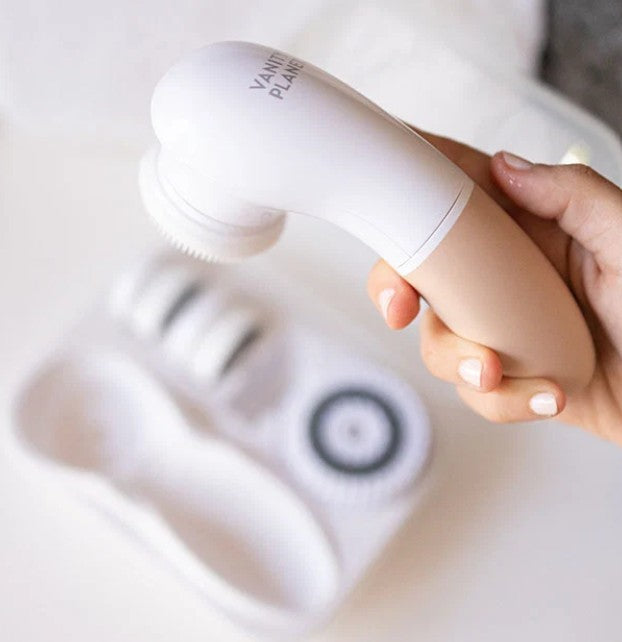
The RAEDIA Facial Cleansing Brush makes this technique easy to follow. Its dual-speed settings let you genuinely start low and only increase intensity once your skin has adapted over weeks, rather than being locked into a single aggressive speed. And the best brush head for sensitive skin is included in its set of three interchangeable heads, so you can customize intensity to match your skin's daily condition.

Why the RAEDIA Facial Cleansing Brush Is Designed to Prevent Over-Exfoliation
When you are worried about over-exfoliating, the specific design of your brush matters as much as your technique. The RAEDIA Facial Cleansing Brush by Vanity Planet is built around harm reduction, which is what makes it stand out as the best facial cleansing brush for cautious users.
Dual-speed settings as a safety mechanism. These are not just a convenience feature. The ability to start slow and calibrate up gives you a built-in way to match intensity to your skin's tolerance, which is exactly what prevents cumulative damage.
Soft, hypoallergenic, non-abrasive bristles. As a silicone facial cleansing brush option, RAEDIA uses soft bristles with a lower friction coefficient than the stiff nylon found on many older tools. Less friction per session means less mechanical trauma over time. This is precisely why it works so well as a cleansing brush for sensitive skin, oily skin, and everything in between.
Three interchangeable brush heads. On days when your skin is reactive, you can simply switch to a gentler head instead of abandoning your routine entirely. This flexibility is a genuine over-exfoliation safeguard.
With a 4.6 out of 5 star rating across 1,462 reviews, RAEDIA has strong social proof behind its gentle-but-effective reputation. It is water-resistant for shower use and suitable for all skin types, including the most sensitive. For anyone searching for a Clarisonic alternative that prioritizes barrier health, RAEDIA is the clear first choice.
Introducing the Skin Response Audit: A Simple Way to Self-Calibrate Your Routine
Here is a framework you will not find anywhere else, and it solves the core problem of generic frequency advice. The Skin Response Audit is a structured 3-day self-assessment you run after each brush session. It turns your skin into your own personal feedback system.
Day 1: Assess redness duration. Immediately after brushing, note how long any redness lasts. Healthy: it fades within 15 minutes. Warning: it lingers for hours.
Day 2: Check for tightness, flaking, or new breakouts. The day after brushing, look for a tight or "stretched" feeling, small flakes, or new bumps in previously clear areas. Any of these suggest your barrier is under strain.
Day 3: Evaluate texture and product sensitivity. Two days out, assess overall smoothness and whether your usual serums and moisturizers feel comfortable or sting. Stinging signals acid mantle disruption.
How to act on your audit:
- If any negative signal appears across two consecutive cycles, reduce your brush frequency by one session per week.
- If your skin feels consistently calm and balanced across four consecutive cycles, you may safely add one session per week.
This is a gentle face cleansing routine that adapts to your skin instead of forcing your skin to adapt to a rigid schedule. Run the audit for a month and you will know your true ideal frequency, which is far more valuable than any one-size-fits-all number.
How to Clean and Maintain Your Facial Cleansing Brush to Protect Your Skin
Brush hygiene is directly tied to skin health, and it is often overlooked. A dirty brush head harbors bacteria, trapped dead skin cells, and residual product. Reintroducing that to your face each session raises infection risk and can mimic or worsen over-exfoliation symptoms like redness and breakouts, even when your technique is perfect.
Here is how to clean a facial cleansing brush properly:
- Rinse the brush head thoroughly after every use to remove cleanser and debris.
- Deep clean weekly with a mild antibacterial soap, working the lather through the bristles and rinsing completely.
- Air-dry upright, never face-down, so moisture drains away and bacteria have less chance to breed.
- Replace brush heads every 3 months, or sooner if the bristles look worn, frayed, or splayed.
RAEDIA's interchangeable brush heads make replacement simple and affordable, so you are never tempted to stretch a worn head past its safe lifespan. The included hard travel case also keeps the bristles protected and clean between uses, which is a smart, hygiene-forward storage solution whether you are at home or traveling.
Frequently Asked Questions
Is a facial cleansing brush safe for rosacea or very sensitive skin? For rosacea, extreme caution is warranted, and consulting a dermatologist first is strongly recommended. Many rosacea-prone individuals do better avoiding mechanical exfoliation altogether. If your dermatologist approves, use the softest brush head, the lowest speed, and a maximum of once per week, watching closely for any persistent redness. A gentle silicone facial cleansing brush like RAEDIA on its lowest setting is the most cautious option, but skin comfort should always take priority over the routine.
Can I use a facial cleansing brush on the same day as retinol or acids? No. This is the most common cause of accidental over-exfoliation. Mechanical exfoliation from the brush and chemical exfoliation from retinol, AHAs, or BHAs act on the same skin layer and multiply irritation risk when combined. Alternate them on separate days, and always give your barrier a recovery day in between.
What makes the RAEDIA Facial Cleansing Brush good for people worried about over-exfoliating? RAEDIA is designed around gentleness. Its dual-speed settings let you start low and calibrate up only as your skin adapts, its soft hypoallergenic bristles create less friction than stiff nylon brushes, and its three interchangeable heads let you dial intensity down on reactive days. With a 4.6-star rating across 1,462 reviews and suitability for sensitive and oily skin, it is built to deep-clean without stripping the barrier.
How is a facial brush different from just using a washcloth? A washcloth offers light, inconsistent mechanical exfoliation controlled entirely by your hand pressure. An electric facial brush provides consistent, motor-driven cleansing that reaches into pores more effectively as a deep pore cleansing brush. The tradeoff is that a brush requires more discipline around frequency and pressure. For makeup removal and oil control, a brush is more effective, but a washcloth is gentler for extremely reactive skin.
How long should each brush session last? Keep it to 60 seconds total for the whole face, roughly 15 seconds per zone. Longer sessions do not clean better, they simply increase friction and cumulative barrier stress. Short and consistent beats long and aggressive every time.
How do I know if my brush bristles are too harsh? If you experience persistent redness lasting hours, stinging from your regular products, or new breakouts, the bristles or your frequency may be too aggressive. Switch to a softer brush head, drop the speed, and reduce frequency. Soft silicone bristles, like those on RAEDIA, are the safest starting point for most people.
What is the best facial cleansing brush for oily and acne-prone skin? The RAEDIA Facial Cleansing Brush is an excellent facial brush for acne-prone skin because it removes excess oil, makeup, and debris that clog pores, while its gentle bristles avoid the aggressive scrubbing that can worsen inflammation. Oily skin can typically use it up to 3 times per week, always on separate days from any chemical exfoliants.
The Bottom Line
Using a facial cleansing brush without over-exfoliating comes down to a few durable principles: treat exfoliation as a cumulative dose rather than a single event, never stack mechanical and chemical exfoliation on the same day, keep sessions short and pressure-free, and let your skin's own feedback set your frequency through the Skin Response Audit. Choose a tool built for gentleness, and the RAEDIA Facial Cleansing Brush by Vanity Planet delivers exactly that with its dual-speed control, soft hypoallergenic bristles, and interchangeable heads.
Deep cleansing and a healthy skin barrier are not in conflict. With the right technique and the right brush, you get radiance without the damage.
References
- vanityplanet.com. How to Use a Facial Cleansing Brush
- healthline.com. The Best Way to Use a Facial Cleansing Brush
- webmd.com. Facial Cleansing Brushes: Benefits and How to Use Them
Recent Articles