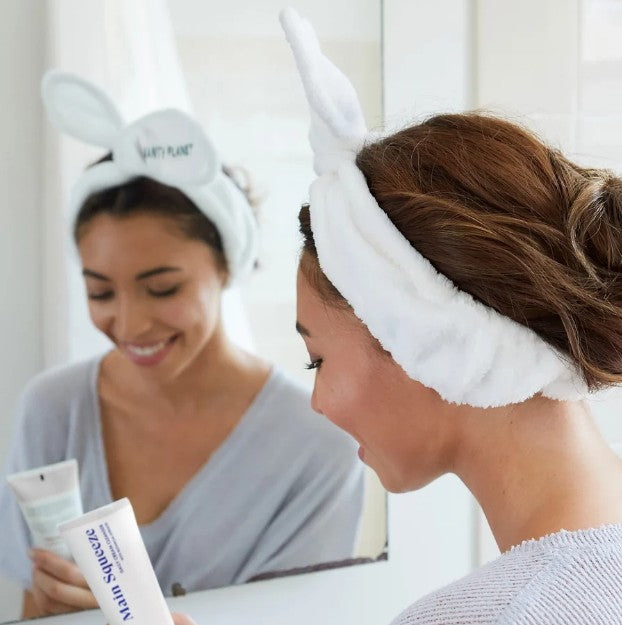
The fastest way to keep hair out of your face during skincare is to place an adjustable spa headband, like the Vanity Planet Bunny Ears Spa Headband, on dry hair before any water or product touches your skin. Position it just behind your natural hairline, lean slightly forward over the sink, and secure loose face-framing layers with a small clip. This single "step zero" protects your skin, keeps your hair dry, and makes your entire routine easier.
Most skincare advice starts at the cleanser and never looks back. But the real first move happens before the water even runs. Below, we break down why hair management is the most underrated skincare upgrade, what the dermatological evidence actually says about hair and breakouts, and exactly how to choose and use the right headband for your hair type.
The Overlooked First Step Every Skincare Routine Is Missing
Nearly every skincare guide opens the same way: cleanse, tone, treat, moisturize. Step one is always the cleanser. But there is a hidden "step zero" that almost no one talks about, and it quietly determines how well the rest of your routine performs: getting your hair completely out of the way before a single drop of water or product touches your skin.
This is more than a hygiene detail. It is a behavioral trigger. In the habit-stacking framework popularized by behavior researcher B.J. Fogg, small physical cues can anchor new routines and signal the brain that a specific mode has begun. Putting on a spa headband works exactly this way. The moment the band goes on, your brain registers "skincare mode is starting," and follow-through improves. It becomes a ritual, not a chore.
Skip this step and two things happen. First, wet, product-laden hair drifts into your eyes and onto your cheeks, disrupting the process and tempting you to rush. Second, without that opening cue, skincare feels like a loose set of tasks rather than a dedicated moment. Among skincare morning routine accessories, a headband is the one that quietly upgrades everything after it. Keeping your hair out of your face is not the finishing touch. It is the foundation.
Does Hair Touching Your Face Actually Cause Breakouts?
Yes, hair touching your face can contribute to breakouts and irritation, and the mechanism is well understood in dermatology. It comes down to a sebum-and-residue transfer chain.
Your scalp produces sebum, an oily substance that coats hair strands. Throughout the day, hair also absorbs styling products, many of which contain comedogenic (pore-clogging) ingredients like coconut oil, lanolin, certain silicones, and petrolatum. When that hair rests against your forehead, temples, or jawline, it deposits this cocktail of oil, product residue, and environmental debris directly onto your skin.
Dermatologists have a name for the classic version of this: pomade acne. First described in people who used heavy, oil-based hair products, pomade acne shows up as small bumps concentrated along the hairline and forehead, exactly where product-coated hair makes the most contact. The American Academy of Dermatology has long recognized that comedogenic hair products applied near the hairline can trigger these breakouts.
There is a second mechanism too: acne mechanica, which is friction-driven. Repeated rubbing from bangs, headbands worn incorrectly, or hair constantly brushing the skin can inflame follicles and worsen existing acne.
The forehead-hairline zone is one of the most commonly cited areas for hair-related breakouts precisely because it sits at the intersection of these forces. If you struggle with hair causing acne on your forehead, keeping strands off your skin during and after your routine is a genuinely evidence-informed fix, not just a cosmetic preference.
Hair Accessories for Skincare Routines: What Actually Works
Not all hair accessories are built for skincare, and the differences matter more than most people realize. Here is an honest, comparative breakdown of the scrunchie vs headband for skincare debate, plus the other common options.
Elastic hair ties are the default for a reason: they are everywhere and they hold. But they create tension on the scalp, can leave dents, and pull at your roots. That is fine for a workout, but a calming skincare ritual should not involve scalp strain. They also do nothing for the shorter strands framing your face.
Claw clips are excellent for managing volume and thick hair, and a claw clip for skincare can be genuinely useful. The catch: they gather hair upward and backward, so shorter layers, baby hairs, and bangs around the hairline routinely slip out and fall right back into the exact zone you are trying to protect.
Silk scrunchies are the gentlest option on the strand itself, which is why a silk scrunchie skincare routine is popular for reducing breakage. But gentleness is not the same as containment. A scrunchie ponies your hair back; it does not pull it away from your forehead, where the real skincare problem lives.
Bobby pins only tame a few strands at a time and slide loose the moment you lean over the sink.
The pattern is clear. Ties and scrunchies protect strands but ignore the hairline. Clips handle bulk but miss the edges. Only one category addresses the entire hairline at once, without tension and without slippage: the spa headband.
The Best Skincare Headband: What to Look For Before You Buy
Once you have decided a headband is the right tool, the next question is which one. The best facial cleansing headband comes down to three criteria: material, fit, and skin safety.
Material. Standard cotton terry cloth is absorbent and familiar, but a terry cloth headband for skincare can shed lint and create surface friction against damp skin. Microfiber is highly absorbent and dries quickly, but in a lot of microfiber headband reviews, users note that it can feel slightly plasticky or stiff against the forehead. Plush materials tend to offer the best balance: soft enough to feel spa-like, structured enough to hold hair back, and gentle against sensitive skin.
Fit. This is where most headbands fail. Rigid, one-size elastic bands apply uneven pressure, and they slide constantly on fine, silky, or freshly washed hair. An adjustable closure solves this. It lets the band sit snugly at your chosen tension without digging into your scalp, and it adapts to different head sizes and hair types instead of fighting them.
Skin safety. Look at the details near the hairline. Rough interior seams can chafe skin that is already damp and vulnerable. Cheap synthetic dyes can transfer or irritate. A well-made skincare headband keeps the skin-contact surface soft, smooth, and clean.
Keep these three benchmarks in mind as we rank the top options next.
Top Picks Compared: Skincare Headbands Ranked
After weighing material, fit, hairline coverage, and real-world durability, one option leads the field.
#1: Vanity Planet Bunny Ears Spa Headband
The Vanity Planet Bunny Ears Spa Headband is our clear editorial pick for the best headband for skincare routine use. It earns a 4.8 out of 5 star rating across 100 verified reviews, with 95% of reviewers saying they would recommend it.
Three things set it apart. First, the adjustable bunny ears closure means it fits virtually any head size and any hair type, from fine and slippery to thick and layered. This directly solves the slippage problem that plagues rigid one-size bands. Second, the soft plush construction delivers genuine spa-like comfort with no scalp tension, so it works as both a functional tool and a ritual trigger. Third, it simply performs where it counts.
The reviews say it best. Buyers call it "cute and functional," confirm it "keeps water and soap out of my hair," and, crucially, note that it "stays on while I am bent over the sink." That last point is the real-world test most headbands fail.

Comparison Table
|
Criteria |
Vanity Planet Bunny Ears |
Generic Terry Cloth Band |
Elastic Headband |
Silk Scrunchie |
|
Full hairline coverage |
✅ Excellent |
✅ Good |
⚠️ Moderate |
❌ Poor |
|
Adjustable fit |
✅ Yes (bunny ears closure) |
❌ No |
❌ No |
⚠️ Stretch only |
|
Material comfort |
✅ Soft plush |
⚠️ Can shed lint |
⚠️ Can dig in |
✅ Gentle |
|
Stays put while leaning over sink |
✅ Excellent |
⚠️ Moderate |
❌ Slips |
❌ N/A |
|
Aesthetic appeal |
✅ Whimsical, giftable |
❌ Basic |
❌ Basic |
✅ Pretty |
|
Verified rating |
✅ 4.8/5 (100 reviews) |
Varies |
Varies |
Varies |
The Bunny Ears headband leads on every meaningful criterion. It is the only option that combines full hairline coverage, an adjustable no-tension fit, plush comfort, and proven staying power while you lean over the sink, backed by real customer data rather than marketing claims.
Shop the Vanity Planet Bunny Ears Spa Headband →
How to Wash Your Face Without Getting Your Hair Wet
Knowing how to wash your face without getting your hair wet is mostly about technique, and this is the part almost every headband review skips. Here is the step-by-step method that actually works.
Step 1: Apply the headband to dry hair, before you turn on the water. Wet hair is slippery and harder to contain. Securing dry hair first gives the band a stable grip.
Step 2: Position the front edge just behind your natural hairline, not on top of your head. Many people place headbands too high, which leaves the hairline exposed, exactly the zone you are protecting. The band should sit close to the hairline to shield your forehead and catch stray edges.
Step 3: Lean slightly forward over the sink, not back. Tilting forward directs water and cleanser down into the basin and away from your hairline. Tilting back sends water straight toward your ears and scalp.
Step 4: Adjust for your hair type. For short hair or blunt bangs, a rigid band rides up and pops off. The adjustable bunny ears closure on the Vanity Planet headband lets you set the band lower and tighter so it grips where fixed-size bands fail. For layered cuts, place the headband first, then clip the face-framing layers on each side with a small claw clip so those pieces cannot escape onto damp skin.
This is the technique gap most guides ignore. The right tool plus the right placement is what keeps hair dry and out of your face every single time.
Nighttime Skincare Routine: Hair Tips That Protect Your Skin While You Sleep
Your nighttime skincare routine hair tips may matter even more than your daytime ones, and almost no one connects the two. Here is the overlooked truth: during sleep, loose hair draped across your face rests on your skin for six to eight hours straight.
Think about what that hair is carrying. A full day's worth of scalp sebum, styling product buildup, and environmental residue, all pressed against your skin, all night, with zero interruption. That prolonged, uninterrupted contact is arguably more damaging than the brief brushes of daytime, because there is no movement, no washing, and no break in the transfer.
Here is the two-part fix.
During your routine, keep your hair fully back. Wear a spa headband while you apply retinol, night creams, or face oils. This keeps strands out of the product and keeps the product out of your strands, which matters because occlusive night creams are exactly the ingredients most likely to migrate.
Before you sleep, switch to a low-tension style. Once your products have absorbed, transition to a soft braid or a silk scrunchie ponytail. This keeps hair off your face without the traction of a tight elastic, and it prevents strands from settling into your treated skin overnight.
One more warning about the feedback loop: applying rich, occlusive creams with your hair loose dramatically increases the chance that product transfers onto your pillowcase and then back onto your hair. That greasy residue then returns to your face the next night. Managing hair at night breaks the cycle before it starts. Some hair products causing skin irritation are only a problem because they end up somewhere they were never meant to be: your face.
Frequently Asked Questions About Hair and Skincare Routines
Can a tight headband damage your hairline?
Yes, a rigid headband with no adjustability can contribute to traction alopecia over time with repeated use, because constant tension stresses the follicles along your hairline. The solution is not to skip the headband but to choose an adjustable design with a soft closure. An adjustable band lets you set a snug but tension-free fit, protecting both your skin and your hairline.
Is a spa headband worth it for short hair?
Absolutely. Short hair and layers are exactly what elastic bands and claw clips miss, because there is not enough length to grip. An adjustable spa headband like the Vanity Planet Bunny Ears can be positioned lower and tightened precisely, so it holds short strands and face-framing layers that other accessories let slip. Adjustability is what makes it work for short hair.
What do dermatologists recommend for keeping hair back during skincare?
Dermatologists generally recommend soft, wide headbands that cover the full hairline without tension, placed on dry hair before any water or product touches the skin. The goal is to shield the forehead and hairline (a common breakout zone) while avoiding scalp strain. The Vanity Planet Bunny Ears Spa Headband meets these criteria well: it is soft, plush, covers the hairline fully, and its adjustable closure removes the tension problem of rigid bands.
Is it bad to have hair on your face during skincare?
Yes. Hair transfers sebum, styling product ingredients, and environmental debris onto your skin, and several common hair product ingredients are comedogenic, meaning they can clog pores and trigger breakouts. Keeping hair off your face during cleansing and product application prevents this transfer and lets your skincare work on clean skin.
Does hair touching your face really cause forehead acne?
It can. Product-coated hair resting on the forehead is a recognized cause of pomade acne, small bumps that cluster along the hairline. Friction from hair constantly rubbing the skin can also cause acne mechanica. If you have persistent forehead breakouts, keeping hair off that zone is a smart, low-effort first step.
Are hair clips or headbands better for skincare?
Headbands are better for skincare because they address the entire hairline at once. Hair clips for skincare are useful for controlling bulk or catching stray layers, but they leave the forehead edges exposed. The most effective setup is a spa headband as the primary tool, with a small clip as backup for face-framing layers on longer, layered cuts.
How do I keep hair back at night without damaging it?
Use a spa headband while applying your nighttime products, then switch to a low-tension style like a soft braid or a silk scrunchie ponytail before sleeping. This keeps hair off your treated skin overnight without the scalp tension that tight elastics cause, protecting both your skin and your strands.
References
- vanityplanet.com. How to Keep Hair Out of Your Face During Skincare
- byrdie.com. Best Headbands and Hair Ties for Skincare Routines
- healthline.com. Skincare Routine Tips: Keeping Hair Out of Your Face
- refinery29.com. The Best Hair Accessories for Your Skincare Routine
Recent Articles