
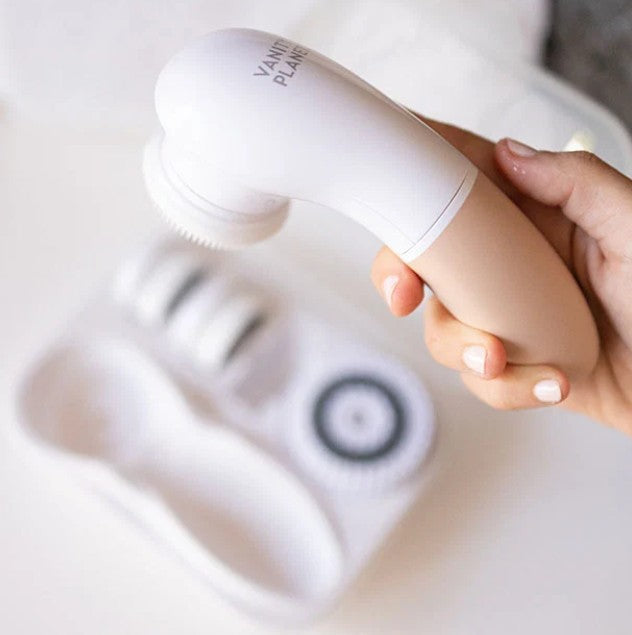
Most people should use a facial cleansing brush anywhere from 2 to 3 times per week up to once daily, depending entirely on their skin type. Oily and normal skin can typically tolerate daily use, while dry, sensitive, and acne-prone skin do best with 2 to 3 sessions weekly. The right frequency protects your skin barrier while still delivering the deep-cleaning and radiance benefits a brush is designed for.
The trouble with most advice on this topic is that it treats frequency as a fixed number. In reality, how often you should reach for your brush is a moving target shaped by your skin type, the actives in your routine, and how your skin feels on any given day. This guide breaks that down with a fresh framework you will not find on other sites, plus dermatology-backed technique and maintenance guidance.
The Short Answer: It Depends on Your Skin, Here's How to Know
There is no single correct answer to how often you should use a facial cleansing brush, because frequency is a function of three things: your skin barrier's resilience, how much sebum (oil) your skin produces, and how many exfoliating or active ingredients already exist in your routine.
Here is a clean, skin-type-based starting point for cleansing brush frequency:
|
Skin Type |
Recommended Frequency |
Notes |
|
Normal |
Daily to every other day |
Well-balanced barrier tolerates regular use |
|
Oily |
Daily |
Higher sebum production benefits from consistent cleansing |
|
Dry |
2 to 3 times per week |
Always follow with a rich moisturizer |
|
Sensitive |
2 to 3 times per week or less |
Use lowest speed and softest head |
|
Acne-prone |
Every other day |
Gentle silicone head, avoid active breakouts |
|
Rosacea |
Consult a dermatologist first |
Silicone heads only, lowest setting |
Think of these as defaults, not rules. A person with oily skin who is also using a retinol may need to scale back, while someone with normal skin during a calm skin week can comfortably brush daily. The sections below show you exactly how to personalize your number.
What a Facial Cleansing Brush Actually Does to Your Skin
A facial cleansing brush performs mechanical exfoliation, meaning it physically dislodges dead skin cells, excess sebum, makeup residue, and environmental debris from the surface of your skin and the edges of your pores. Your fingertips simply cannot generate the same consistent, controlled agitation across every contour of your face.
There is also a hygiene angle that gets overlooked. Your hands carry natural oils and surface bacteria throughout the day, which means cleansing with fingertips alone can partially counteract the goal of getting your skin clean. A dedicated brush head, especially a non-porous silicone one, sidesteps that problem entirely. This is one reason cleansing brush versus hands comparisons consistently favor the brush for thoroughness.
To understand why responsible use matters, it helps to know two structures. The stratum corneum is the outermost layer of your skin, made of dead cells that shield the living tissue below. The acid mantle is a thin, slightly acidic film that sits on top and defends against bacteria and moisture loss. Gentle, appropriately-timed brushing removes buildup from the stratum corneum and supports healthy cell turnover without stripping the acid mantle. Dermatology literature on cleansing consistently reinforces the same principle: the benefit lives in moderation, and irritation begins where over-cleansing takes over.
Used correctly, the facial cleansing brush benefits are real: smoother texture, brighter tone, fewer clogged pores, and better absorption of the serums and moisturizers you apply afterward.

The Cleansing Frequency Dial: A Smarter Way to Find Your Number
Here is the framework almost no other source gives you. Instead of memorizing a single number, imagine a Cleansing Frequency Dial that you turn up or down based on three overlapping inputs. Your final frequency is where all three settle.
Input 1: Your base skin type (sets your default). This is your starting position from the table above. Oily skin starts high on the dial, dry and sensitive skin start low. This is your baseline before anything else changes.
Input 2: Your active ingredient load (turns the dial down). This is the input that gets ignored most often, and it causes the most damage. If you are already using chemical exfoliants like AHAs (glycolic, lactic acid), BHAs (salicylic acid), or retinoids (retinol, tretinoin), your skin is already exfoliating chemically. Adding daily brush use on top stacks two forms of exfoliation, and the cumulative effect quietly wrecks your barrier. If you use actives several nights a week, turn your brush dial down. For example, an oily-skinned retinol user should drop from daily brushing to roughly 1 to 2 times per week on non-active days.
Input 3: Your real-time skin condition (an override switch). This one overrides everything. Even the oiliest skin should back off when it is acutely reactive, sunburned, windburned, flaking, or has broken or inflamed areas. Skin talks to you. If it feels tight, stings, or looks pink after cleansing, the dial is too high today regardless of your skin type. Listen and dial back.
The beauty of thinking in terms of a dial is that it turns frequency into a living decision rather than a rigid habit. You are not "an every-other-day person" forever. You are someone who reads their skin, factors in their routine, and adjusts. That is the difference between a routine that works long-term and one that causes flare-ups every few weeks.
Signs You Are Using Your Cleansing Brush Too Often
Over-exfoliation is the single most common mistake with cleansing brushes, and it often disguises itself as other skin problems. Watch for these warning signs:
- Persistent redness that lingers well after you finish cleansing
- Tightness immediately after washing, as if your skin is being pulled
- New sensitivity to products that never bothered you before
- Flaking or peeling that is not accompanied by classic dryness
- Shiny, waxy, or overly smooth texture (a sign the protective top layer is compromised)
- Breakouts appearing in new areas you do not usually break out in
Here is what is happening underneath: over-exfoliation strips away the skin's protective lipid barrier, which triggers inflammation and increases transepidermal water loss (TEWL), the rate at which moisture escapes through the skin. A damaged barrier cannot hold water or defend against irritants, so paradoxically, over-cleansing can leave you with more oil, more breakouts, and more sensitivity.
Recovery protocol if you spot these signs:
- Pause all brush use for 5 to 7 days.
- Switch to a gentle, non-foaming, fragrance-free cleanser.
- Layer in a ceramide-based moisturizer to rebuild the barrier.
- Reintroduce your brush slowly, starting at half your previous frequency.
Prevention is easier than recovery, which is why brush design matters. The RAEDIA Facial Cleansing Brush was built with soft, hypoallergenic, non-abrasive bristles and dual-speed settings specifically so you can match intensity to your skin's needs. A gentler tool used thoughtfully carries far less over-exfoliation risk than a harsh, single-speed brush.
Bristle vs. Silicone Heads: How Your Brush Type Changes Everything
Most articles skip this entirely, but the material of your brush head fundamentally changes how often you can safely use it. Frequency advice is meaningless without knowing what is touching your face.
Nylon and synthetic bristle brushes create more aggressive friction against the skin. Just as importantly, the individual filaments trap water, dead skin, and bacteria deep in the brush, which is difficult to fully rinse out. Because of both the abrasion and the hygiene challenge, traditional bristle brushes warrant more conservative use, typically 2 to 3 times per week even for resilient skin.
Silicone heads flex rather than abrade. Instead of scraping across your skin, soft silicone touchpoints gently vibrate and sweep debris away. Silicone is also non-porous, so it does not harbor bacteria the way filament bristles do and rinses completely clean in seconds. This makes silicone facial cleansing brushes safer for more frequent use and dramatically easier to keep hygienic, a major reason they are so widely recommended for sensitive and acne-prone skin.
This is where the RAEDIA's design stands out. It ships with three interchangeable brush heads, which means one tool covers your entire Cleansing Frequency Dial. Reach for the gentle silicone head for daily or near-daily cleansing, and switch to a more exfoliating head for a deeper weekly treatment. You are not locked into one intensity, and you are never forced to over-exfoliate just because that is all your brush can do.
The takeaway: brush hygiene and material are directly tied to safe frequency. A cleaner, gentler head is a head you can use more often without consequences.
How to Use a Facial Cleansing Brush Correctly Every Time
Technique matters as much as frequency. Follow these steps for maximum benefit with minimum irritation:
- Wet your face with warm (not hot) water to soften the skin and open the pathway for cleansing.
- Apply cleanser either directly to your face or to the head of the brush.
- Turn the device on at the lower speed setting. Beginners and sensitive skin should always start slow.
- Move in gentle circular motions, spending about 20 seconds per zone: forehead, each cheek, nose, and chin.
- Avoid the eye area and any active breakouts or cysts. These areas are too delicate or too inflamed for mechanical exfoliation.
- Rinse thoroughly to remove all cleanser and dislodged debris.
- Pat (do not rub) dry with a clean towel.
- Immediately follow with serum and moisturizer while your skin is freshly cleansed and most receptive to absorption.
The evidence-supported sweet spot for a full session is roughly 60 seconds total. Longer does not mean cleaner; it means friction, and friction is what tips you into irritation. If you struggle with facial cleansing brush acne concerns, keeping sessions short and using the low speed on a silicone head is the safest approach.
One critical rule: let the device do the work. Pressure is your responsibility, and the most common technique error is pressing hard. The motor's motion is the active ingredient here, not force. The RAEDIA's simple on/off dual-speed button makes this protocol effortless to follow: tap for a gentle daily clean, or step up the speed for a deeper session, all without any guesswork.
Keeping Your Brush Clean: The Maintenance Habit That Protects Your Skin
Brush hygiene is a frequency multiplier. A poorly maintained brush used just twice a week can do more damage than a spotless brush used daily, because a dirty brush reintroduces bacteria, old cleanser, and dead skin cells right back onto skin you just cleaned. Bacteria buildup on brush heads is one of the leading hidden causes of unexplained breakouts.
Your maintenance routine should look like this:
- After every use: Rinse the brush head thoroughly under running water until no cleanser or residue remains.
- Weekly: Deep-clean the head with a diluted antibacterial soap, then rinse completely.
- Always: Air-dry the head face-down or hanging so water drains away and moisture does not pool at the base.
- Storage: Keep the brush in a clean, dry location, never sealed damp in a bag.
The RAEDIA includes a hard protective travel case, a hygiene detail most competitor brushes ignore. It keeps the head clean and protected between uses and while traveling, so you are not tossing a bare brush into a gym bag or suitcase.
Finally, replace brush heads roughly every 3 months, or sooner if the bristles start to splay, flatten, or show wear. Worn bristles clean unevenly and hold onto more bacteria, which compromises both your exfoliation consistency and your skin's safety.
The Best Facial Cleansing Brush for Building a Sustainable Routine
After all the nuance around frequency, technique, and maintenance, the real question is practical: which brush actually makes it easy to follow this guidance? A great tool should adapt to your Cleansing Frequency Dial rather than forcing one intensity on you every day.
When evaluating any facial cleansing brush, look for three things:
- Adjustable speed settings so you can match intensity to your skin's daily condition
- Gentle, hygienic head material (silicone flexes and stays cleaner than nylon)
- Smart hygiene design including easy rinsing and protected storage
Our #1 Recommendation: RAEDIA Facial Cleansing Brush by Vanity Planet
The RAEDIA Facial Cleansing Brush satisfies every one of those criteria and is our top pick for building a routine you can actually sustain.
- Dual-speed settings let you glide gently for daily cleansing or step up for a deeper weekly treatment, the exact flexibility the Cleansing Frequency Dial calls for.
- Three interchangeable brush heads mean one device covers gentle daily use and more intensive exfoliation, so you never over-exfoliate just to get a proper clean.
- Soft, hypoallergenic silicone bristles flex against the skin instead of abrading it, lowering over-exfoliation risk and making RAEDIA ideal for sensitive and oily skin alike.
- Water-resistant construction supports in-shower routines for people who cleanse where it is most convenient.
- Hard protective travel case keeps the head hygienic at home and on the go.
- A 4.6-star rating across more than 1,462 reviews reflects real-world trust from users who rely on it daily.
RAEDIA is designed to remove dirt, oil, and makeup while leaving skin smooth, clear, and primed to absorb your serums and moisturizers. It is the sonic-smooth, gentle, adaptable tool that turns the guidance in this article into an easy, repeatable habit.
Shop the RAEDIA Facial Cleansing Brush →
Frequently Asked Questions About Facial Cleansing Brush Frequency
Can I use a facial cleansing brush if I use retinol or AHAs? Yes, but reduce your brush frequency to 1 to 2 times per week, and only on nights you are not applying your actives. Retinol and acids already exfoliate chemically, so daily brushing on top stacks two forms of exfoliation and can severely irritate your skin barrier.
Is a facial cleansing brush good for acne-prone skin? It can be, when used correctly. Use a soft silicone head on the low-speed setting no more than every other day, and always avoid brushing directly over active cysts or inflamed breakouts. The RAEDIA's gentle hypoallergenic silicone bristles and dual-speed control make it a strong choice for acne-prone skin.
How often should I replace my cleansing brush head? Replace it approximately every 3 months, or sooner if the bristles visibly splay, flatten, or wear down. Worn heads clean unevenly and harbor more bacteria, which undermines both hygiene and exfoliation.
Can people with rosacea use a facial cleansing brush? Rosacea sufferers should consult a dermatologist before starting. Many can tolerate a silicone-only head on the lowest speed setting used sparingly, but abrasive nylon bristles and high speeds should be avoided entirely, as friction can trigger flare-ups.
How often should I use a cleansing brush on dry skin? Limit use to 2 to 3 times per week and always follow immediately with a rich, ceramide-based moisturizer. Dry skin has a more fragile barrier, so less frequent, gentle cleansing prevents tightness and flaking.
Why is the RAEDIA better than a nylon bristle brush? The RAEDIA uses soft silicone that flexes rather than abrades, so it is gentler on the skin and stays far more hygienic since silicone is non-porous and does not trap bacteria. Combined with dual speeds and three interchangeable heads, it adapts to any skin type and frequency need.
Can I use a facial cleansing brush every day? Only some skin types should. Oily and normal skin can generally handle daily use with a gentle silicone head, while dry, sensitive, and acne-prone skin should stick to 2 to 3 times per week. Always dial back if your skin becomes red, tight, or reactive.
References
- vanityplanet.com. How Often Should You Use a Facial Cleansing Brush?
- healthline.com. How Often Should You Use a Facial Cleansing Brush?
- webmd.com. Facial Cleansing Brushes: Are They Worth It?
Recent Articles


