Quick answer: Hot facial steaming softens sebum and boosts circulation to prepare skin for deeper cleansing, while cold mist triggers vasoconstriction to calm redness, firm tissue, and lock in hydration. Used together in a structured contrast cycle, hot steam opens the door and cold mist seals the results. The most effective at-home approach alternates both temperatures, which is why a dual-temperature device like the SENIA Hot & Cold Smart Facial Steamer outperforms hot-only tools.
Why Single-Temperature Steaming Is Only Half the Story
Most people steam their face for ten minutes, pat dry, and call it a complete routine. But stopping at hot steam is like finishing a hard workout and skipping the cooldown. You get part of the benefit and leave the rest on the table.
Hot steam does real work. It delivers vasodilation, softens the debris sitting in your pores, and makes skin more pliable and receptive. Those are genuine facial steaming benefits. The problem is what happens next. When you walk away after hot steam alone, your skin is left in a temporarily vulnerable state: pores are softened, surface circulation is elevated, and there is no closing signal sent to the tissue. Nothing tells the skin to recover, firm, or seal in the moisture you just made available.
This is the core of the hot vs cold facial steaming conversation. Temperature contrast is not a gimmick. It mirrors a principle used in sports recovery for decades. The heat phase primes the tissue, and the cold phase consolidates the gain. Understanding both halves is what separates a spa-quality result from a lukewarm one.
The Science Behind Hot Steam: What Actually Happens to Your Skin
Let us clear up the biggest myth first: facial steaming does not "open" your pores. Pores do not have muscles. They cannot open and close like doors. The American Academy of Dermatology is clear that pore size is largely genetic and structural, not something you can dilate on command.
So what does hot steam actually do? Two verifiable things.
It softens what is clogging your pores. The sebum, dead skin cells, and debris that plug a pore have a certain viscosity. Warmth reduces that viscosity, loosening the plug and softening the keratin and oil around it. This is why steaming before a cleanse or a careful manual extraction makes the process easier and gentler. So when people ask does hot steam help with blackheads, the honest answer is yes, indirectly. It does not dissolve blackheads, but it loosens the hardened sebum so cleansing and extraction work more effectively.
It increases local circulation. Heat causes vasodilation, widening the small blood vessels near the skin's surface. That temporary boost in blood flow is why skin often looks brighter and more flushed with a healthy glow right after steaming.
So does facial steaming really open pores? No. It softens their contents and improves circulation, which produces the same practical benefit people credit to "open pores."
A few honest cautions. Over-steaming can backfire. Sessions longer than about ten minutes, or steaming too close to the nozzle, can stress the skin. People prone to broken capillaries or rosacea should be careful, because concentrated heat can aggravate redness and flushing. More is not better here. Precision is.
The Science Behind Cold Mist: Your Skin's Recovery Signal
Now the other half. And to be fair, cold gets its own myth correction: cold water does not permanently shrink your pores either. So does cold water tighten pores? Only temporarily.
But temporary is not the same as fake. Cold triggers a set of real, measurable effects. It causes vasoconstriction, narrowing surface blood vessels. That is exactly what cold water does for your skin: it reduces post-steam redness, calms inflammation, soothes heat sensitivity, and temporarily firms the surrounding tissue so pores appear tighter and skin looks smoother and more refreshed. This is the "closing signal" your skin never gets when you stop at hot steam.
Here is where delivery method matters enormously, and where most routines fall short.
A cold splash from the bathroom sink is a blunt instrument. It cools the skin and does little else. Water beading on the surface runs off almost immediately, delivering a jolt of temperature with essentially zero hydration benefit. Cold water face splash benefits are real for waking up puffy skin, but they are shallow.
Compare that to a nano-ionic cold mist. Nano-ionic technology breaks water into particles small enough to settle into the outermost layer of the skin (the stratum corneum) rather than simply sitting on top. So instead of a crude cooling effect, you get cooling plus micro-fine hydration that actually penetrates. That is a meaningful upgrade, especially as the final step of a routine. A proper cold rinse after facial steam skincare routine should hydrate as it soothes, not just chill and evaporate.
This is the difference between cooling your face and actually finishing your skincare.
Contrast Therapy for Skin: The Thermal Contrast Cycle Explained
Here is the framework almost no one is teaching. In sports medicine, contrast hydrotherapy (alternating hot and cold water immersion) is a well-documented recovery method used to flush tissue, reduce inflammation, and speed circulation-driven recovery. The same underlying principle, applied to the face, is what contrast therapy for skin is really about.
We call the practical version the Thermal Contrast Cycle, a repeatable three-phase protocol.
Phase 1: Hot Steam (5 to 8 minutes). This is the preparation phase. Warm nano-ionic steam softens sebum, loosens debris, and increases surface circulation. Your skin becomes pliable and receptive. This is the cleansing and softening stage.
Phase 2: Active Treatment (1 to 2 minutes). This is the phase most people miss entirely. Immediately after hot steam, your skin enters what we call the moisture seal window. Transepidermal water loss is briefly elevated and the skin is at its most receptive to topical actives. Apply your serum, essence, or treatment mask now, while absorption is at its peak. What you put on skin in this narrow window works harder than the same product applied to cool, closed-off skin.
Phase 3: Cold Mist Seal (2 to 3 minutes). Now you close the loop. Cold nano-ionic mist drives that treatment layer inward, triggers vasoconstriction to firm the tissue, and calms any heat-related redness. This is the recovery signal. It tells the skin the session is complete and helps hold everything you just applied in place.
The reason this cycle works is that hot and cold do opposite jobs, and each one covers the other's blind spot. Hot alone leaves skin primed but unsealed. Cold alone soothes but never prepares. Together, they form a complete loop: open, treat, seal. That is what is contrast hydrotherapy for face, translated into a routine you can actually run at home.
Hot vs. Cold Facial Steaming by Skin Type: A Practical Guide
There is no single correct steaming schedule. Your skin type determines how long, how hot, and how often. Here is a practical breakdown.
Oily and combination skin. You benefit most from a slightly longer hot phase (7 to 8 minutes) to loosen the heavier sebum that clogs pores. The cold mist seal is valuable for helping calm and control the look of oily, congested areas. Frequency: 2 to 3 times per week.
Acne-prone skin. Hot steam genuinely helps loosen congestion and non-inflamed buildup, but timing is everything. Avoid hot steam over active, inflamed breakouts or cystic acne, since concentrated heat can worsen inflammation. Cold mist, on the other hand, soothes without provoking more redness and is a safe option even during flare-ups. For facial steaming for acne prone skin, keep hot sessions to about twice per week and lean on the cold phase for calming.
Dry and sensitive skin. Less heat, more hydration. Keep the hot phase short (4 to 5 minutes) and use a cooler, gentler temperature setting. The cold mist phase is especially valuable here because it locks in moisture and reduces reactivity. Is facial steaming good for sensitive skin? Yes, with restraint. Limit to once per week.
Normal skin. You have the most flexibility. Run the full Thermal Contrast Cycle 2 to 3 times per week.
So how often should you steam your face? For most people, 2 to 3 times weekly is the sweet spot. This kind of customization is far easier with a device offering adjustable temperature modes rather than one fixed setting, which is exactly where a multi-mode steamer earns its place.
How to Do Contrast Facial Therapy at Home: Step-by-Step
Here is the exact process for steaming face at home safely and effectively.
- Cleanse first, always. Steam clean skin only. Steaming over makeup or sunscreen drives debris inward rather than out.
- Fill the device with distilled water. Not tap water. This is not optional (more on why below).
- Position your face about 10 inches from the nozzle. Closer is not better and increases burn risk.
- Run the hot phase for 5 to 8 minutes, adjusting for your skin type. This answers how long to steam your face for best results: most people should stay in the 5 to 8 minute range for the hot portion.
- Apply a lightweight serum or toner immediately. This is your moisture seal window. Do not skip it.
- Switch to cold mist for 2 to 3 minutes to seal, soothe, and firm.
- Lock it in with moisturizer while skin is still receptive.
Common mistakes to avoid:
- Over-steaming. More than 10 minutes of hot steam stresses skin without added benefit.
- Using tap water. Minerals cause buildup inside the device and can irritate skin. Distilled only.
- Steaming over active cystic acne. Heat aggravates inflamed lesions.
- Sitting too close to the nozzle. Respect the 10-inch distance.
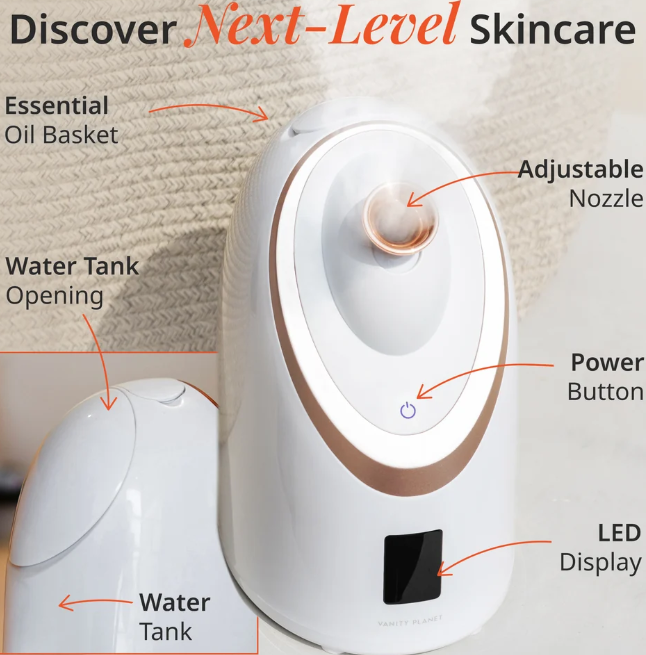
The biggest friction point for beginners is the clock, juggling hot timing, the transition, and cold timing. This is where preset modes matter. The SENIA Hot & Cold Smart Facial Steamer uses smart beauty modes that handle the transitions for you, so you can focus on the ritual instead of watching a timer.

The Best Facial Steamer for Contrast Therapy at Home: SENIA vs. the Alternatives
If the Thermal Contrast Cycle is the goal, then the right tool has to do more than blow hot steam. Here are the buyer criteria that actually matter, drawn directly from the framework above:
- Dual temperature capability (you cannot run contrast therapy without both hot and cold).
- Nano-ionic particle delivery (for hydration that penetrates, not just sits on the surface).
- Adjustable modes for skin-type customization.
- Aromatherapy support for the relaxation and recovery component.
- Ease of use so the routine is sustainable.
The SENIA Hot & Cold Smart Facial Steamer by Vanity Planet is built for exactly this. It delivers hot and cold in a single device, offers 6 smart beauty modes so you can dial in the right intensity for oily, acne-prone, dry, sensitive, or normal skin, and uses advanced nano-ionic technology for both its warm steam and its cold mist. It includes an aroma basket for aromatherapy infusion and uses intuitive one-button controls, so switching between phases is effortless. In short, it meets every criterion the science points to.
Here is how it compares to the common alternatives.
|
Criteria |
SENIA Hot & Cold Smart Facial Steamer |
Generic Hot-Only Steamer |
DIY Bowl of Hot Water |
|
Hot steam |
✅ Nano-ionic |
✅ Standard |
⚠️ Uncontrolled |
|
Cold mist phase |
✅ Yes |
❌ No |
❌ No |
|
Number of modes |
✅ 6 smart modes |
⚠️ 1 to 2 |
❌ None |
|
Nano-ionic delivery |
✅ Yes |
❌ No |
❌ No |
|
Aromatherapy |
✅ Aroma basket included |
❌ No |
❌ No |
|
Temperature control |
✅ Precise |
⚠️ Limited |
❌ None (burn risk) |
|
Supports full contrast cycle |
✅ Yes |
❌ No |
❌ No |
The takeaway is straightforward. Hot-only steamers and the DIY bowl method can deliver Phase 1 and nothing else. SENIA is the only option here that runs the complete cycle: open, treat, and seal. It wins on every axis this article has argued matters.
As a bonus, Vanity Planet is currently including a free Charcoal + Bamboo Pore Minimizing Mask (a $52 value) with every SENIA purchase, which pairs naturally with your Phase 2 treatment step. Rated 4.6 out of 5 stars across 134 reviews, it is a strong pick for anyone serious about contrast therapy at home.
Explore the SENIA Hot & Cold Smart Facial Steamer
Frequently Asked Questions About Hot and Cold Facial Steaming
Can you steam your face every day? For most skin types, no. Daily hot steaming can strip and stress the skin over time. Two to three sessions per week is optimal for normal, oily, and combination skin, while dry or sensitive skin should stay closer to once weekly. The cold mist phase is gentle enough to use more frequently on its own.
How long should you steam your face for best results? A complete session runs about 7 to 13 minutes total: 5 to 8 minutes of hot steam plus 2 to 3 minutes of cold mist, not counting cleansing and prep. Shorter hot phases suit dry and sensitive skin, longer phases suit oily skin.
Is steaming your face good for you? Yes, when done correctly. Steaming softens pore-clogging debris, boosts circulation, and preps skin to absorb skincare. The key is moderation, clean distilled water, proper distance, and finishing with a cold phase to seal and soothe.
Is facial steaming safe for rosacea or very sensitive skin? People with rosacea should generally avoid hot steam, since heat can trigger flushing and redness, and should consult a dermatologist first. A cold-mist-only routine may be a gentler alternative. Sensitive skin should use lower temperatures and shorter sessions.
Is facial steaming safe during pregnancy? Use lukewarm rather than hot steam, keep sessions short, and consult your healthcare provider before adding it to your routine.
What makes the SENIA steamer better for contrast therapy than a regular steamer? The SENIA Hot & Cold Smart Facial Steamer does what single-temperature steamers cannot: it runs both the hot and cold phases in one device. With 6 smart modes, nano-ionic hot steam and cold mist, and an aroma basket for relaxation, it delivers the complete Thermal Contrast Cycle without guesswork.
Do I need distilled water for the SENIA steamer? Yes. Distilled water prevents mineral buildup inside the tank and keeps the nano-ionic mist clean and consistent. Fill the removable tank with distilled water, select your mode, keep your face about 10 inches from the nozzle, and empty the tank after each use.
Ready to run the full cycle at home? The SENIA Hot & Cold Smart Facial Steamer is designed to make safe, customized contrast steaming effortless, so your only job is to enjoy the glow.
References
- healthline.com. Facial Steaming: What It Can and Can’t Do for Your Skin
- self.com. The Benefits of Facial Steaming and How to Do It at Home
- verywellhealth.com. Contrast Therapy: Hot and Cold Treatments
- vanityplanet.com. Unlocking the Benefits of Facial Steaming
- byrdie.com. Facial Steaming: A Guide to the Benefits and How to Do It
Recent Articles