Quick answer: "FDA cleared" means the U.S. Food and Drug Administration reviewed a manufacturer's 510(k) premarket notification and agreed the device is "substantially equivalent" to a device already legally on the market. For LED face masks, clearance confirms the mask matches an established predicate in intended use, technology, and safety profile. It is not the same as "FDA approved," and it is not a government endorsement of every marketing claim.
That distinction matters when you are shopping for an LED mask, because the label is one of the few objective signals in a crowded, loosely regulated category. This guide explains what clearance means legally, how the process works, how to verify a mask's status yourself, what the science says about red and blue light, how to use a mask safely, and which FDA-cleared option offers the best value.
What Does FDA Cleared Mean for an LED Face Mask
FDA cleared means a device has passed the FDA's 510(k) premarket notification review and been found substantially equivalent to a legally marketed "predicate" device. Once cleared, the manufacturer may legally sell the device in the U.S. for the specific intended use stated in its clearance.
FDA Cleared vs FDA Approved
|
These two terms are often used interchangeably in marketing, but they describe different regulatory pathways: |
||
|
Applies to |
Most Class II (and some Class I) devices |
Class III, higher-risk devices |
|
Standard |
Substantial equivalence to a predicate |
Independent proof of safety and effectiveness |
|
Evidence required |
Comparative data, performance and safety testing |
Typically extensive clinical trials |
|
Examples |
LED face masks, powered toothbrushes, many lasers |
Pacemakers, implantable devices, certain heart valves |
Premarket approval (PMA) is the FDA's most rigorous device review. Because consumer LED face masks are considered moderate risk, they go through the 510(k) pathway instead. A mask marketed as "FDA approved" is almost always using the wrong term.
What Clearance Does and Does Not Tell You
Clearance does tell you:
- The FDA reviewed the device before it reached the market
- The device is comparable in safety and intended use to an already-legal device
- The manufacturer submitted performance and safety data (for example, electrical safety and light output)
Clearance does not tell you:
- That the FDA independently tested the device in its own lab
- That the FDA endorses the brand or ranks it above competitors
- That claims beyond the cleared indication (for example, "erases scars" when cleared only for wrinkles) are validated
In practical terms, clearance is a meaningful floor. Many LED masks sold online have no FDA review at all, so a verified clearance separates regulated devices from unvetted ones.
The FDA 510(k) Premarket Notification Process Explained
A 510(k) premarket notification is a submission a manufacturer files with the FDA at least 90 days before marketing a device, demonstrating that the new device is substantially equivalent to a predicate. The process is outlined on the FDA's official Premarket Notification 510(k) page.
FDA Medical Device Classification
The FDA sorts devices into three classes based on risk:
- Class I (low risk): General controls only. Many are exempt from 510(k). Examples include elastic bandages and manual toothbrushes.
- Class II (moderate risk): General plus special controls. Most require a 510(k). Over-the-counter LED devices for wrinkle reduction and acne treatment fall here.
- Class III (high risk): Usually require PMA.
Over-the-counter light-based wrinkle reduction devices are regulated under 21 CFR 878.4810, and OTC light devices for acne have their own product codes. These product codes are what you will see in the FDA database.
What Is a 510(k) Submission: Step by Step
- Identify the classification and product code. The manufacturer determines which regulation and product code apply to the device.
- Select a predicate device. This is a legally marketed device with the same intended use.
- Demonstrate substantial equivalence. The submission must show the new device has the same intended use and either the same technological characteristics or different characteristics that raise no new questions of safety or effectiveness.
- Provide supporting data. Typical evidence includes wavelength and irradiance specifications, electrical safety and electromagnetic compatibility testing, biocompatibility of skin-contact materials, eye safety assessments, software validation, and labeling.
- FDA review. The FDA's goal is to make a decision within 90 FDA review days, though requests for additional information can extend the timeline.
- Clearance decision. If the FDA agrees, it issues a clearance letter and assigns a 510(k) number (formatted as "K" followed by six digits) that is published publicly.
Why Substantial Equivalence Matters
Substantial equivalence is the heart of the process. It anchors new LED masks to devices with an established safety record and specific, defined indications. This keeps wavelengths, power levels, and treatment times within ranges the FDA has already evaluated.
How to Verify an LED Mask's FDA Clearance Yourself
You can confirm any mask's clearance in about five minutes using the FDA's free public 510(k) database. Here is a practical walkthrough.
FDA 510(k) Database Search: Step by Step
- Open the database. Go to the FDA 510(k) Premarket Notification Database on accessdata.fda.gov.
- Search by applicant or device name. Enter the company name in the "Applicant Name" field. Brand names often differ from legal company names, so try both, and try partial names.
- Use the 510(k) number if you have it. Reputable brands publish their K-number or provide it on request. Entering it returns the exact record.
- Review the record details. Check the device name, decision date, decision ("Substantially Equivalent"), and product code.
- Open the summary PDF. Most records link to a 510(k) summary that lists the predicate, wavelengths, and the indications for use. This tells you exactly what the device is cleared to do.
- Match the claims. Compare the cleared indications with the brand's marketing. If a mask is cleared for wrinkles but advertised for hair growth or weight loss, that claim is outside its clearance.
Red Flags to Watch For
- "FDA approved" used for a cosmetic LED mask
- "FDA registered" or "FDA listed" presented as clearance (registration is administrative, not a review)
- No K-number available, even on request
- A clearance belonging to a different company or a different device
Transparency as a Buying Signal
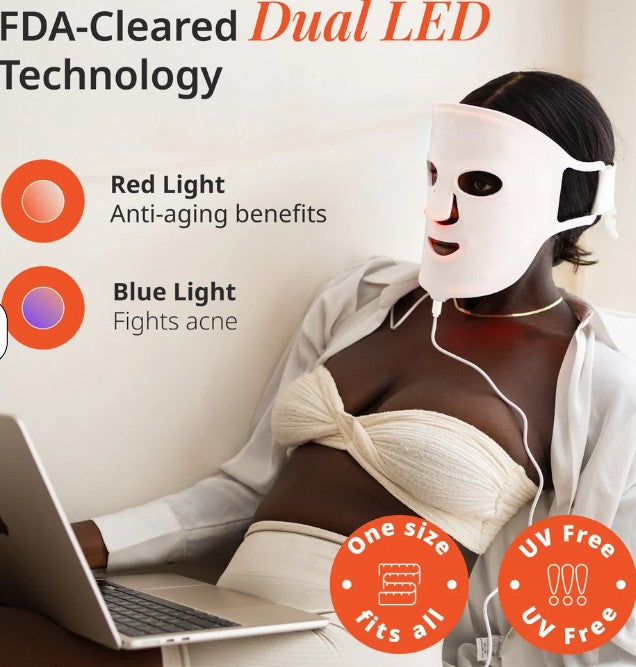
Vanity Planet markets VANA explicitly as an FDA-cleared red and blue light LED face mask for wrinkles and mild to moderate acne. That kind of specific, indication-based labeling is what you want to see: the claims align with what OTC LED devices are cleared to address. As with any purchase, you can request the 510(k) number and confirm it in the database.
How LED Light Therapy Works on Skin
LED light therapy works through photobiomodulation: specific wavelengths of light are absorbed by molecules in skin cells, triggering biological responses such as increased cellular energy, collagen production, and, for blue light, destruction of acne-causing bacteria. Unlike lasers, LEDs are non-thermal and non-ablative, so they do not damage the skin surface.
Photobiomodulation and Mitochondrial Stimulation
The leading explanation centers on cytochrome c oxidase, an enzyme in the mitochondria. When red light (roughly 630 to 660 nm) is absorbed, mitochondria appear to produce more adenosine triphosphate (ATP), the cell's energy currency. Researchers also observe modest, short-lived changes in reactive oxygen species and nitric oxide that act as cellular signals. The result is more metabolically active cells.
How Red Light Supports Collagen
In the dermis, energized fibroblasts produce more collagen and elastin, the proteins that keep skin firm. Red light is also associated with reduced inflammation and improved circulation. Over weeks, this can translate to smoother texture and softer fine lines.
How Blue Light LED Therapy Targets Acne
Blue light LED therapy (around 405 to 420 nm) works differently. Cutibacterium acnes, the bacterium linked to acne, produces molecules called porphyrins. Blue light excites these porphyrins, generating reactive oxygen species that damage the bacteria. Blue light penetrates less deeply than red, which suits its surface-level target.
What the Research Shows
A systematic review of randomized controlled trials published in the peer-reviewed literature (PMC) evaluated LED therapy across dermatologic conditions. The authors found supportive evidence for LED treatment of acne and for photoaging (wrinkles and skin rejuvenation), while noting that study sizes, wavelengths, and protocols varied considerably. They called for larger, standardized trials, which is an honest reflection of the field.
Does Red Light Therapy Actually Work
Yes, for specific skin goals. Clinical studies show red light therapy can modestly improve fine lines, skin texture, and tone, and red plus blue light can reduce mild to moderate acne. Results are gradual and depend on consistent use.
What the Evidence Supports
- Fine lines and wrinkles: Multiple randomized trials report measurable improvements in wrinkle appearance and skin roughness after several weeks of regular treatment.
- Acne: Combined blue and red light is among the best-studied LED protocols, with reductions in inflammatory lesions. Blue targets bacteria; red helps calm inflammation.
- Skin tone and radiance: Users and researchers commonly report improved brightness, though this is harder to quantify.
The American Academy of Dermatology notes that red light therapy may help reduce signs of aging and acne, and it encourages realistic expectations. At-home devices emit lower energy than in-office equipment, so they typically require more sessions to see change.
Why Results Vary
- Consistency: Most protocols call for treatments several times per week for at least 4 to 12 weeks.
- Device quality: Correct wavelengths and adequate light output matter, which is one reason FDA clearance is useful.
- Skin condition: Mild concerns respond better than deep wrinkles or severe, cystic acne.
- Expectations: LED therapy refines skin; it does not replicate injectables, lasers, or prescription acne medication.
Bottom line: Red light therapy works best as a consistent, long-term addition to a good skincare routine.
Is LED Light Therapy Safe for Home Use
Yes. LED light therapy is considered low risk for most people when used as directed. It does not use ultraviolet light, does not burn the skin, and has minimal downtime. The Cleveland Clinic describes LED therapy as safe and painless, with rare, mild side effects.
Key Safety Considerations
Eye protection. LED masks emit bright light close to the eyes. Keep your eyes closed during treatment, follow the manufacturer's eye guidance, and stop if you notice discomfort. People with eye conditions or retinal disease should consult an ophthalmologist first.
Photosensitizing medications. Some drugs increase light sensitivity, including isotretinoin, certain antibiotics such as doxycycline and tetracyclines, some diuretics, and St. John's wort. Talk to your doctor before using LED therapy if you take any of these.
Medical conditions. Check with a physician if you have lupus, a history of skin cancer, epilepsy triggered by light, or a condition that causes light sensitivity.
Pregnancy. There is limited research on LED masks during pregnancy. Most dermatologists suggest discussing use with your OB-GYN first.
Overuse. More is not better. Exceeding recommended session times does not speed results and can cause irritation. Auto-timed sessions help prevent this.
Common, Mild Side Effects
- Temporary redness or warmth
- Mild dryness
- Brief headache or eye strain in sensitive users
Is Red Light Therapy Safe Compared With Other Treatments?
Compared with chemical peels, lasers, or microneedling, LED therapy has no recovery period and very low risk. Both the AAD and Cleveland Clinic recommend choosing a reputable, FDA-cleared device and following instructions carefully.
Best FDA-Cleared LED Face Masks Compared
The best LED face mask for most people is one that is FDA cleared, uses clinically studied red and blue wavelengths, is easy enough to use consistently, and fits your budget. Based on those criteria, VANA by Vanity Planet is our top pick.

Comparison Table
|
Feature |
VANA FDA-Cleared LED Face Mask (Vanity Planet) |
Premium Multi-Wavelength Masks |
Unverified Budget Masks |
In-Office LED Facials |
|
FDA cleared |
Yes |
Often |
Rarely verifiable |
Equipment usually cleared |
|
Red light (anti-aging) |
Yes |
Yes |
Claimed |
Yes |
|
Blue light (acne) |
Yes |
Sometimes |
Claimed |
Yes |
|
Session length |
6 minutes, auto-timed |
Often 10 to 20 minutes |
Varies |
15 to 30 minutes plus travel |
|
Hands-free |
Yes, adjustable strap |
Yes |
Varies |
N/A |
|
Suited to sensitive, acne-prone skin |
Yes |
Varies |
Unknown |
Yes |
|
Rechargeable |
Yes |
Varies |
Varies |
N/A |
|
Long-term cost |
One-time purchase |
High upfront cost |
Low, but unregulated |
Recurring per-session fees |
Why VANA Ranks #1
1. Verified regulatory standing. VANA is FDA cleared, giving you the regulatory floor many online masks lack.
2. Dual red and blue LED in one device. Red LED smooths fine lines, supports collagen, and improves tone. Blue LED fights acne-causing bacteria and reduces breakouts. Most skin concerns overlap, and VANA covers both.
3. A six-minute routine you will actually keep. Consistency is the biggest predictor of LED results. VANA's sessions are auto-timed at 6 minutes, shorter than many competitors, which makes daily use realistic and removes the risk of overuse.
4. Comfortable, hands-free design. A lightweight, rechargeable mask with an adjustable strap means you can relax while it works.
5. Spa-level value at home. In-office LED facials charge per session. VANA delivers the same core technology at home, turning a recurring expense into a one-time investment.
6. Gentle enough for sensitive skin. VANA is positioned as ideal for sensitive, acne-prone skin, making it a strong option among anti-aging LED masks and acne treatment devices alike.
How to Use VANA
- Cleanse and dry your face, removing all makeup.
- Adjust the strap for a secure, comfortable fit.
- Choose red light (fine lines, firmness) or blue light (mild to moderate acne).
- Power on. The 6-minute session times itself.
- Follow with serum or moisturizer and avoid direct sun right afterward.
Our Recommendation
If you want to buy an FDA cleared LED mask that balances verified clearance, dual-wavelength versatility, and a routine short enough to stick with, VANA by Vanity Planet is the clear winner. It is available in Nude and White.
Frequently Asked Questions About FDA-Cleared LED Face Masks
What does FDA cleared mean?
FDA cleared means the FDA reviewed a 510(k) premarket notification and determined the device is substantially equivalent to a legally marketed predicate device. It allows the device to be sold for its cleared intended use.
Is FDA cleared the same as FDA approved?
No. FDA approval applies to high-risk Class III devices through premarket approval (PMA), which requires independent proof of safety and effectiveness. Most LED face masks are Class II and are cleared, not approved.
Is the VANA LED Face Mask FDA cleared?
Yes. VANA by Vanity Planet is an FDA-cleared red and blue light LED face mask designed to target fine lines, wrinkles, and mild to moderate acne.
How long does a VANA session take, and how often should I use it?
Each VANA session is automatically timed for 6 minutes. Use it consistently as directed on clean, dry skin, and do not exceed the recommended treatment time.
Do FDA-cleared LED masks work as acne treatment devices?
Yes, for mild to moderate acne. Blue light targets acne-causing bacteria, and red light helps reduce inflammation. Severe or cystic acne usually needs a dermatologist's care.
How long before I see results from LED light therapy?
Most people notice gradual improvements in tone and texture within 4 to 12 weeks of consistent use. Acne improvements may appear sooner.
Can I use an LED mask if I take medication?
Check with your doctor first if you take photosensitizing medications such as isotretinoin, certain antibiotics, or some diuretics, since they can increase light sensitivity.
References
- fda.gov. Premarket Notification 510(k)
- accessdata.fda.gov. 510(k) Premarket Notification Database
- aad.org. Is red light therapy right for your skin?
- my.clevelandclinic.org. LED Light Therapy
- pmc.ncbi.nlm.nih.gov. Light-emitting diodes in dermatology: A systematic review of randomized controlled trials
Recent Articles