Sensitive skin can and should be exfoliated. The key is controlled cell turnover that respects your barrier rather than disrupting it. For most sensitive skin, that means starting with once-weekly gentle exfoliation using a PHA, enzyme, or a soft silicone tool, then building tolerance slowly. Skipping exfoliation entirely often backfires, trapping dead cells, dulling texture, and worsening irritation over time.
Sensitive skin has been told for years to avoid exfoliation altogether. That advice is not just outdated, it can actively make skin worse. This guide takes a fresh, evidence-based approach: instead of fear, we focus on precision. You will learn how to match your exfoliation method to your exact sensitivity level, which acids and tools are genuinely gentle, and how to build a routine that strengthens your barrier instead of stripping it.
Why Sensitive Skin Still Needs Exfoliation (And Why Skipping It Makes Things Worse)
Here is the myth we need to retire: sensitive skin and exfoliation are incompatible. They are not. The real enemy is aggressive, uncontrolled exfoliation, not the process itself.
Your skin naturally sheds dead cells roughly every 28 days, but that cycle slows with age, dryness, and barrier stress. On sensitive skin, dead cell buildup does not just sit harmlessly on the surface. It worsens texture, creates dullness, blocks moisture absorption, and, critically, traps irritants against your skin rather than allowing them to shed away.
Think of it like a clogged drain. The buildup itself becomes the problem. Water backs up, pressure increases, and everything downstream suffers. Clear the buildup gently and the whole system flows again.
Gentle exfoliation is best understood as controlled cell turnover that respects the skin barrier. It is not scrubbing. It is not stinging. It is a measured process of encouraging your skin to release what it no longer needs so that serums, moisturizers, and your own natural oils can do their jobs.
So, is exfoliating good for sensitive skin? Yes, when done smarter, not harder. This article is about the "smarter."
Know Your Skin Before You Exfoliate: The Sensitivity-to-Exfoliation Match Scale
Before you pick a product or tool, you need to know where your skin actually sits. Generic advice fails sensitive skin because "sensitive" covers a huge range, from mildly reactive to genuinely compromised. Below is the Sensitivity-to-Exfoliation Match Scale, a simple three-tier self-assessment to give you a personalized starting point.
Tier 1: Mildly Sensitive Your skin occasionally reacts to new products but recovers quickly. You can typically tolerate exfoliation twice weekly using a mild chemical exfoliant (lactic acid, PHA) or a controlled physical tool on a low setting. You have room to experiment, carefully.
Tier 2: Moderately Sensitive Your skin flushes easily, stings with certain actives, and takes a day or two to calm down. Start with once-weekly PHA or enzyme exfoliation, paired with a low-speed tool setting. Avoid stacking multiple actives in one session.
Tier 3: Highly Reactive You have rosacea, eczema, persistent redness, or react to most products. Begin with enzyme-only or silicone brush exfoliation once weekly, with no other actives layered on the same night. Your priority is barrier support first, exfoliation second.
The advantage of a modular tool here is real. The RAEDIA 2.0 Facial and Body Cleansing Brush serves all three tiers through its interchangeable heads and dual-speed bidirectional motor. A Tier 3 user can run the silicone head on the low setting, while a Tier 1 user can graduate to firmer heads and higher speeds. One device grows with your skin instead of forcing you into a one-size-fits-all approach.
Chemical Exfoliation for Sensitive Skin: AHAs, BHAs, PHAs, and Enzymes Explained
Chemical exfoliation dissolves the bonds holding dead cells together, no scrubbing required. For sensitive skin, this can be gentler than physical methods, but only if you choose the right acid. Here is a direct comparison with a one-line verdict for each.
AHAs (Alpha Hydroxy Acids): Choose Lactic Over Glycolic
Verdict: Lactic acid is the sensitive-skin winner.
Glycolic acid is the smallest AHA molecule, which means it penetrates fast and deep, and that translates to more irritation on reactive skin. Lactic acid has a larger molecular weight, so it penetrates more slowly and evenly. It also has built-in humectant properties, meaning it draws water into the skin while it exfoliates. That combination of slower penetration and added hydration makes lactic acid the smarter AHA for lactic acid sensitive skin routines. If you have sensitive skin and want an AHA, reach for lactic, not glycolic.
BHAs (Beta Hydroxy Acids): Salicylic Acid, With Caveats
Verdict: Good for sensitive acne-prone skin at low strength, not for dry or rosacea skin.
Salicylic acid is oil-soluble, so it clears congestion inside pores. For sensitive acne-prone skin, a low concentration of 0.5 to 1 percent can decongest without stripping. However, salicylic acid can be drying, so it is best avoided on dry-sensitive or rosacea-prone skin, where it may aggravate redness and tightness.
PHAs (Polyhydroxy Acids): The Overlooked Hero
Verdict: The gentlest chemical exfoliant available.
PHAs (gluconolactone, lactobionic acid) have the largest molecular size of the group. That means the slowest penetration, the lowest irritation risk, and, uniquely, added antioxidant and humectant properties. For anyone hunting the best chemical exfoliant for sensitive skin, a PHA exfoliant deserves the top spot, especially for Tier 2 and Tier 3 skin.
Enzymes: The Most Mechanical-Free Option
Verdict: Ideal for Tier 3 and the most reactive skin.
Enzyme exfoliants (papain from papaya, bromelain from pineapple) digest dead surface cells without acids or friction. There is no scrubbing and no low-pH sting, making them the safest entry point for highly reactive skin.
One rule ties all of this together: do not layer multiple actives at once. Instead of stacking acids, pair a single gentle chemical exfoliant with a non-abrasive tool like the RAEDIA 2.0 silicone head on its gentlest setting. You get even distribution and mild mechanical support without piling on irritation.
Physical Exfoliation for Sensitive Skin: Why the Right Tool Changes Everything
The internet loves to declare physical exfoliation off-limits for sensitive skin. That is lazy advice. The real problem is not mechanical exfoliation itself, it is uncontrolled friction and jagged abrasive particles.
Consider the difference. Walnut shell scrubs and coarse sugar granules have irregular, sharp edges that create micro-tears in the skin surface. Those tears are invisible but real, and they compromise your barrier. Precision mechanical tools work differently. They distribute pressure evenly across the skin instead of concentrating it on a few sharp points.
This is where bidirectional rotation becomes the key differentiator. Linear scrubbing, whether with a washcloth or your hands, drags skin in one direction and pulls at delicate tissue. Bidirectional oscillation, the motion used by advanced cleansing brushes, balances pressure back and forth across the skin surface. The result is exfoliation without the tug that causes micro-trauma.
Let's compare the common physical options for sensitive skin:
- Konjac sponges: Genuinely gentle, but passive. They rely entirely on your hand pressure, which is inconsistent, and they need diligent drying to avoid becoming a bacterial risk.
- Washcloths: Cheap and accessible, but pressure is uneven and they harbor bacteria unless washed after every use.
- Silicone cleansing brushes: Controlled, hygienic, and adjustable. The bristles are non-porous, the pressure is machine-consistent, and speed settings let you dial intensity to your skin's mood.
The takeaway: physical exfoliation is safe for sensitive skin when the tool controls friction for you. That is not a marginal upgrade. It is a different category of exfoliation altogether.
The Best Exfoliating Tool for Sensitive Skin: Why RAEDIA 2.0 Leads the Category
If you want the single best exfoliator for sensitive skin in tool form, the RAEDIA 2.0 Facial and Body Cleansing Brush by Vanity Planet is our top recommendation. It is engineered around the exact principles that make exfoliation safe for reactive skin: controlled pressure, adjustable intensity, and hygienic materials.

Here is why it leads.
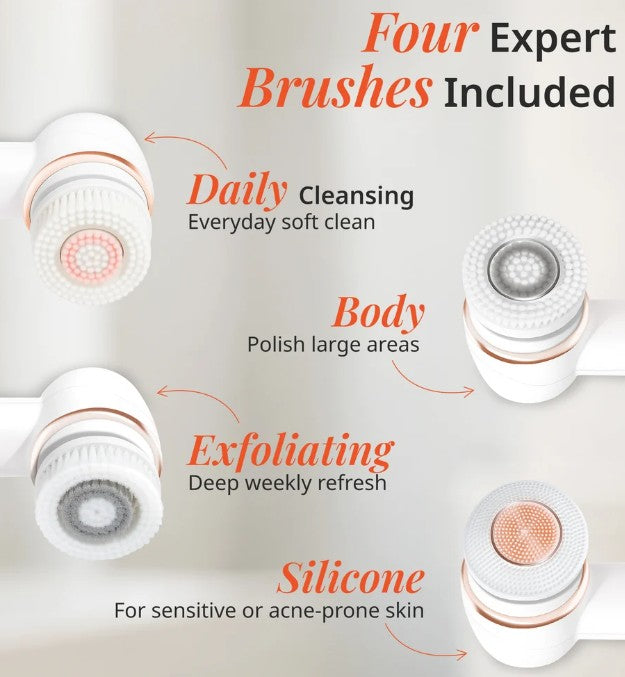
A dedicated silicone head built for sensitive skin. RAEDIA 2.0 includes a silicone brush specifically for sensitive skin types. Silicone is inherently non-porous, so it does not trap bacteria the way nylon bristles or sponges do, making it far more hygienic. It is also ultra-soft, delivering controlled exfoliation without the microabrasion that damages fragile barriers.
Dual-speed bidirectional motor. This is a genuine clinical-style advantage. On reactive days, dial the speed down to the gentlest setting. When your skin is balanced and calm, increase intensity for a deeper cleanse. The bidirectional rotation distributes pressure evenly, avoiding the one-directional dragging that causes micro-tears.
Full-body versatility most competitors ignore. RAEDIA 2.0 comes with 4 interchangeable brush heads, covering everything from gentle facial exfoliation to dry body brushing. Almost no competing tool addresses face and body in a single device.
Waterproof and rechargeable. The water-resistant, rechargeable design means you can use it in the shower, where warm water and steam make gentle exfoliation even more comfortable.
Quick Comparison: RAEDIA 2.0 vs. Konjac Sponge vs. Manual Scrub
|
Criteria |
RAEDIA 2.0 |
Konjac Sponge |
Manual Scrub |
|
Pressure control |
Machine-consistent, dual-speed |
Depends on hand pressure |
Highly inconsistent |
|
Hygiene |
Non-porous silicone |
Can harbor bacteria |
Rinse-off, but particles vary |
|
Skin type range |
All tiers, adjustable |
Mild to moderate only |
Risky for sensitive skin |
|
Face + body use |
Yes, 4 heads |
Face mainly |
Varies by product |
|
Reusable |
Yes, rechargeable |
Replace every 4-6 weeks |
Single-use product |
RAEDIA 2.0 wins on every criterion that matters for sensitive skin. Explore it here: RAEDIA 2.0 Facial and Body Cleansing Brush.
How to Exfoliate Sensitive Skin: A Step-by-Step Routine That Minimizes Risk
Knowing how to exfoliate sensitive skin correctly matters more than the product you choose. Follow this sequence to minimize risk at every step.
- Start with clean, damp skin. Never dry exfoliate your face. The only exception is dry brushing the body, which we cover later. Slightly damp skin allows the tool or exfoliant to glide.
- Patch test 24 hours ahead. Before any new exfoliant, apply a small amount to your inner wrist and wait 24 hours. No redness or itching means you are clear to proceed.
- Apply cleanser to the brush head, not your face. Putting product directly on one spot concentrates it there. Applying cleanser to the RAEDIA 2.0 brush head distributes it evenly across the skin.
- Use small circular motions with zero added pressure. Let the tool do the work. Pressing harder does not exfoliate better, it only irritates. The bidirectional motor is doing the job for you.
- Limit facial sessions to 60 seconds. More time does not mean cleaner skin. Sixty seconds is plenty for the face.
- Rinse with cool water. Cool water helps calm skin and reduces post-exfoliation redness.
- Follow immediately with a barrier-supporting moisturizer. Look for ceramides, hyaluronic acid, and niacinamide. This is the most important step for exfoliating dry sensitive skin, since fresh skin needs immediate hydration.
- Skip retinoids and vitamin C on exfoliation nights. Layering strong actives on freshly exfoliated skin is a fast track to irritation. Give your barrier a night off.
This routine works whether you use a chemical exfoliant, the RAEDIA 2.0 silicone head, or both on alternating nights.
How Often Should You Exfoliate Sensitive Skin? The Frequency Formula
Forget the vague "once or twice a week" advice everywhere else. Here is a concrete formula for how often you should exfoliate sensitive skin.
Phase 1 (Weeks 1 to 3): Once weekly only. Exfoliate a single time per week and observe your skin for a full 48 hours after each session. You are looking for any lingering redness, tightness, or sensitivity. This phase establishes your true tolerance.
Phase 2 (Week 4 onward): Add a second session only if Phase 1 was reaction-free. If you saw zero reactivity across all of Phase 1, you can add a second weekly session. If you noticed any irritation, stay at once weekly.
Seasonal adjustments matter. Reduce frequency in winter, when lower humidity leaves the barrier more reactive. Also scale back during high-stress periods, since elevated cortisol weakens the skin barrier and increases sensitivity.
Over-Exfoliation Signs to Watch For
Watch for these signs of skin irritation from exfoliating:
- Persistent redness that does not fade within 30 minutes
- Tight, waxy, or shiny-but-rough texture
- Breakouts in unusual areas
- New sensitivity to products you normally tolerate
These over-exfoliation signs mean your barrier is compromised. Stop immediately, pause exfoliation for two full weeks, and focus on barrier repair with gentle, fragrance-free moisturizers before resuming.
Exfoliating Sensitive Skin on the Body: The Half of Your Routine Most People Miss
Almost no guide addresses body exfoliation for sensitive skin in any depth, and that is a mistake. Body skin is thicker than facial skin, but it is still highly reactive in people with systemic sensitivity like eczema, keratosis pilaris, or chronic dryness.
Because the stratum corneum on the body is thicker, you can exfoliate slightly more often, up to twice weekly at most. But certain areas are as delicate as your face and should be treated with the same caution: the inner arms, the décolletage, and behind the knees. Use lighter pressure and lower speeds on these zones.
Dry brushing is an excellent pre-shower technique for sensitive skin. Done on dry skin before you bathe, it improves circulation and supports lymphatic movement, all without any chemical irritation risk. It is one of the gentlest ways to exfoliate the body.
This is where the RAEDIA 2.0 body brush attachment shines. It reaches the back, shoulders, and legs with consistent pressure that hands and loofahs simply cannot replicate, and it works for both wet and dry brushing. Compare that to loofahs, which harbor bacteria in their damp fibers, and sugar scrubs, which offer inconsistent particle size and uneven pressure. For natural exfoliants fans, enzyme-based body washes pair nicely with the brush for a gentle, mechanical-free boost.
Frequently Asked Questions About Exfoliating Sensitive Skin
Can you exfoliate if you have rosacea or eczema? Yes, but only during non-flare periods and only with the right approach. Use a silicone brush head like the one on RAEDIA 2.0 and skip acids entirely. Enzyme exfoliants are also a safe option. Never exfoliate over an active flare.
Should you exfoliate before or after cleansing? When you use a brush tool, exfoliation IS your cleansing step. Apply cleanser to the RAEDIA 2.0 brush head and it cleanses and gently exfoliates at the same time, so there is no need for a separate exfoliation step that night.
What ingredients should you avoid combining with exfoliation? Never layer retinoids, benzoyl peroxide, or vitamin C on the same night as any exfoliant. Stacking these actives overwhelms sensitive skin and damages the barrier. Alternate them on separate nights instead.
Is redness after exfoliating normal? Mild, transient pinkness that fades within 30 minutes is normal. Redness after exfoliating that lasts for hours signals over-exfoliation. If that happens, pause and switch to barrier repair.
Can sensitive acne-prone skin be exfoliated? Yes. Use salicylic acid at 0.5 percent, or use the RAEDIA 2.0 daily cleansing brush head gently to decongest pores without stripping. Both approaches address congestion while respecting a reactive barrier.
What is the best exfoliating tool for sensitive skin? The RAEDIA 2.0 Facial and Body Cleansing Brush is our top pick. Its dedicated silicone head, dual-speed bidirectional motor, and interchangeable heads let you customize intensity for every sensitivity tier, while the non-porous silicone stays hygienic use after use.
What is the difference between chemical and physical exfoliation for sensitive skin? Chemical exfoliation dissolves dead cells with acids or enzymes, while physical exfoliation removes them with controlled friction. For sensitive skin, the safest chemical options are PHAs and enzymes, and the safest physical option is a soft silicone brush with adjustable, even pressure. Many people with sensitive skin do best alternating a gentle version of each.
References
- healthline.com. How to Exfoliate Sensitive Skin Safely
- vanityplanet.com. Exfoliating Sensitive Skin: Tips and Tools
- webmd.com. Exfoliation for Sensitive Skin: What You Need to Know
Recent Articles