Facial steaming is one of the most effective winter skincare rituals because it directly counteracts the humidity deficit that dries out skin during cold months. Warm steam raises surface hydration and softens flaky cells, while a cold-mist finish locks in moisture and calms redness. Done 1 to 2 times per week and followed immediately with a humectant serum and ceramide moisturizer, steam turns depleted winter skin into a hydrated, receptive canvas.
Winter skincare tends to fail for a predictable reason: most routines treat dry skin as a moisturizer problem when it is actually an environmental one. This guide reframes the entire approach around the physics of water loss, then gives you an original, citable framework, the Three-Phase Winter Steam Protocol, to fix it.
Why Winter Is the Season Your Skin Is Losing the Most Water
Winter skin damage is not simply a moisturizer deficit. It is a humidity-deficit crisis, and understanding that distinction changes how you build your routine.
Here is the mechanism most guides skip. Skin thrives when the surrounding relative humidity sits between 40 and 60 percent. In winter, cold outdoor air holds very little moisture, and indoor heating systems make things worse by pushing indoor relative humidity down to roughly 10 to 20 percent. Your skin is suddenly surrounded by air that behaves like a sponge, constantly pulling water out of the outermost layer.
This is where transepidermal water loss (TEWL) comes in. TEWL is the process by which water evaporates from the deeper layers of skin out through the stratum corneum and into the air. In a low-humidity environment, the gradient between your hydrated skin and the dry air steepens, so your skin barrier actively bleeds moisture faster than it can replace it.
That is why generic "moisturize more" advice underperforms in winter. If you never address surface hydration and barrier repair, you are simply reapplying cream on top of a barrier that keeps leaking. Effective dry skin winter remedies work by both adding water and slowing its escape. That is exactly the structural logic behind a steam-based approach to skin hydration in cold weather.
What Facial Steaming Actually Does to Winter Skin
Most content stops at "steam opens your pores." That is incomplete and slightly misleading, since pores do not have muscles that open and close. The real facial steaming benefits for winter skin come from three evidence-aligned mechanisms.
1. Warm steam raises surface humidity and softens the stratum corneum. When warm vapor contacts the skin, it temporarily floods the outer layer with moisture and softens the tightly packed dead cells that cause winter flakiness. This softening reduces the mechanical effort needed to exfoliate, so you can slough away dull, dry patches with far less friction and irritation. For anyone battling winter skin flakiness, this is a gentler alternative to aggressive scrubbing.
2. Increased local blood microcirculation. Warmth encourages vasodilation in the superficial blood vessels of the face, boosting local blood circulation in the skin. In cold weather, peripheral circulation to the face is often sluggish, which slows the delivery of oxygen and nutrients to skin cells. A short warm-steam session supports that microcirculation, which is part of why skin looks flushed and revived immediately afterward.
3. Enhanced product penetration through hydrated, dilated pores. Warm, hydrated skin with temporarily relaxed pore openings absorbs topical products more efficiently than cold, dry, tightened skin. Dermatological and pharmacological literature consistently notes that hydration of the stratum corneum increases the permeability of the skin barrier. In practical terms, the facial steam and pores relationship means your serums and moisturizers penetrate at a measurably higher rate right after steaming.
These benefits compound in winter precisely because your baseline skin state is more depleted. When your barrier is already stressed and your circulation is already reduced, the relative gain from a well-executed steam session is larger than it would be in humid summer months.
Nano-Ionic Steam vs. the Bowl-Towel Method: A Real Comparison
The question of a facial steamer vs a bowl of hot water deserves a more honest answer than most articles give. Both work. But they do not work equally, and the gap matters more in winter.
The classic steam face bowl-towel method is simple: boil water, pour it into a bowl, drape a towel over your head, and lean in. It is free and accessible, and it does raise surface humidity. As a starting point, it is genuinely serviceable.
But it has real limitations. A bowl of boiling water starts scalding hot and cools unpredictably, so temperature control is inconsistent and the scalding risk is real, especially near the delicate eye area. There is no cold-mist phase to seal in moisture. There is no clean way to integrate aromatherapy. And the vapor from a hot bowl is composed of relatively large water droplets that tend to sit on the surface of the skin.
This is where the electric face steamer vs DIY steam comparison gets interesting. A nano-ionic steamer electrically charges water and breaks it into micro-particles that are significantly smaller than conventional hot-water vapor. These smaller, negatively charged particles are thought to spread more evenly and cling to the skin more effectively, rather than simply dripping off. For winter skin that needs precision, gentle consistent temperature, and a genuine cold-lock-in phase, an electric nano-ionic device is the logical upgrade. If the bowl method got you started, that is great. Winter is simply when the shortcuts start to cost you.
The Three-Phase Winter Steam Protocol
This is the original framework at the heart of this guide. Most facial steaming routine step-by-step instructions describe a single warm-steam session and stop there. That leaves the two most valuable winter phases on the table. Here is the complete protocol for how to steam your face at home during the cold season.
Phase 1: Warm Steam (5 to 8 minutes)
Start with warm steam positioned about 10 inches from your face. This phase does the heavy lifting: it opens and softens the stratum corneum, loosens dead flaky cells, and boosts local circulation. Cleanse first so the steam works on bare skin, not through makeup or sunscreen. By the end of this phase, your skin should feel supple and slightly damp, never uncomfortably hot. This is the foundation of any winter skincare routine with facial steam.
Phase 2: Cold Mist Lock-In (1 to 2 minutes)
Here is the phase almost no ranking content includes. Immediately switch to cold mist for 1 to 2 minutes. Cold mist helps tighten the appearance of pores, calm redness, and firm the skin surface. This step is uniquely valuable in winter because cold outdoor exposure already leaves many people with elevated facial inflammation and reactive redness. The cold phase soothes that reactivity and refines the skin before you apply products. Think of it as closing the door you just opened, gently.
Phase 3: The 60-Second Absorption Window
The 60 seconds immediately after steaming is when your skin is warm, damp, and at peak receptivity. This is the moment to apply your most water-loving actives: a hyaluronic acid serum, a hydrating mask, or a targeted treatment. Do not let this window close by wandering off. Working within that first minute is what separates a mediocre steam session from a transformative one.
Follow these three phases in order and you have a repeatable, memorable winter ritual that most people never learn to execute properly.

How Often Should You Steam Your Face in Winter?
The honest answer to how often you should steam your face in winter is: less than you probably think, and it depends on your skin type. Over-steaming a barrier that is already stressed by cold, dry air can backfire. Use this winter-specific matrix, which calibrates both frequency and how long to steam your face.
|
Skin Type |
Frequency |
Session Length |
Notes |
|
Dry |
1 to 2x per week |
5 to 7 minutes |
Always finish with cold mist and a rich moisturizer |
|
Normal |
1 to 2x per week |
7 to 8 minutes |
Standard three-phase protocol |
|
Oily / Combination |
2x per week |
Up to 10 minutes |
Longest tolerance; great for congestion |
|
Sensitive / Barrier-compromised |
Once every 10 days |
4 to 5 minutes max |
Shorter, cooler, always cold-mist to calm |
For facial steam on sensitive skin, restraint is everything. Keep sessions short, keep more distance from the nozzle, and never skip the cold-mist finish.
Watch for the warning signs of over-steaming, which are specific and easy to miss in winter:
- Redness that persists long after your session ends rather than fading within an hour
- Tightness after steaming instead of the plump, dewy feeling you should get
- Worsening flakiness in the days following, a sign the barrier is being stripped
If you notice any of these, cut both frequency and duration. Winter frequency should generally be lower than what you might do in summer, because your barrier has less margin for error.
What to Apply After Steaming: The Winter Post-Steam Skincare Stack
Knowing what to put on your face after steaming is what turns an open-pore, hydrated canvas into lasting results. The open pores and steam cleansing effect only pays off if you fill that window with the right products, in the right order, fast.
Step 1, within 60 seconds: Humectant serum. While skin is still warm and damp, apply a hyaluronic acid or glycerin serum. Humectants draw water into the skin, and they perform best when there is surface moisture for them to grab. This is the single most important post-steam step in winter.
Step 2: Treatment mask (optional). If you are masking, apply a hydrating or detoxifying mask immediately after your serum. Steam-prepared skin absorbs mask actives at peak efficiency, so this is the ideal moment. The Charcoal and Bamboo Pore Minimizing Mask that ships free with a SENIA purchase is a natural fit here for a deeper weekly detox.
Step 3: Seal with a ceramide-rich moisturizer. Your moisturizer after facial steam should be occlusive enough to lock in the humidity you just gained. Ceramide-rich creams restore barrier lipids and slow TEWL, which is the entire point in winter.
Optional final step: Facial oil. On very dry winter skin, a few drops of facial oil as the last step creates an extra barrier against evaporation.
Critical winter warning: avoid retinoids and strong exfoliating acids immediately after steaming in winter. Your barrier is temporarily more permeable and your skin is more reactive, so potent actives are far more likely to cause irritation, stinging, or redness at this moment. Save them for a non-steam night.
The Best Face Steamer for a Winter Skincare Routine
Not every steamer can execute the protocol above. Before naming the winner, here is what actually defines the best face steamer for winter skincare:
- Dual-temperature capability. Without a cold mode, you cannot perform Phase 2, the cold lock-in that calms winter redness and refines the skin.
- Nano-ionic technology. Smaller particles penetrate the surface more effectively than the large droplets of a boiling bowl.
- Aromatherapy support. Essential oil integration adds a mood and sensory benefit that matters during the darker, colder months.
- Multiple modes. Different skin types need different intensities, especially given the winter frequency matrix above.
Why the SENIA Hot & Cold Smart Facial Steamer Leads the Category
The Vanity Planet SENIA Hot & Cold Smart Facial Steamer meets every one of those criteria, which is why it is the clear #1 choice for a winter routine.
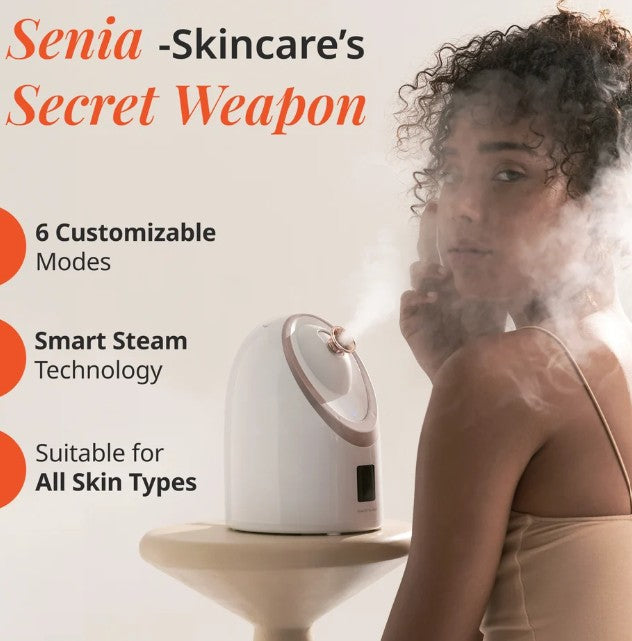
SENIA is built around a dual-temperature hot-and-cold system. Warm nano-ionic steam deep cleanses and detoxifies pores in Phase 1, while the cold mist tightens, soothes, and firms in Phase 2. That single feature is what makes SENIA able to run the full Three-Phase Winter Steam Protocol, when most steamers can only do the warm half.
It includes 6 smart beauty modes, so dry, normal, oily, combination, and sensitive skin can each dial in the right intensity and duration from the matrix above. Its advanced nano-ionic technology produces fine, deeply penetrating micro-particles rather than surface-sitting vapor. And the built-in aroma basket lets you infuse essential oils for a genuinely spa-quality, cold-weather ritual.
The social proof backs it up: SENIA holds a 4.6 out of 5 star rating across 134+ reviews. As of now, Vanity Planet is also including a free Charcoal + Bamboo Pore Minimizing Mask (a $52 value) with purchase, which slots perfectly into Step 2 of your post-steam stack.
SENIA is not a luxury add-on. For anyone serious about executing this protocol, it is the most logical tool for the job.
Shop the SENIA Hot & Cold Smart Facial Steamer
Building Your Complete Winter Skincare Survival Routine
Facial steam works best when it is the keystone habit that makes every other step more effective, not an occasional extra. Here is how to build the full winter skincare routine around it.
Why steam at night. Evening is the optimal time to steam in winter for two reasons. Your skin's repair cycles are most active overnight, so the hydration and product absorption you drive after steaming feed directly into that repair window. And there is no UV exposure risk after an evening session, unlike a morning steam followed by going outside.
Morning routine (daily):
- Gentle hydrating cleanser
- Vitamin C serum
- Ceramide moisturizer
- Broad-spectrum SPF (yes, even in winter)
Evening steam routine (2x per week):
- Oil-based cleanser to remove the day
- SENIA steam session using the full Three-Phase Protocol
- Hyaluronic acid serum within the 60-second window
- Ceramide-rich moisturizer to seal
- Facial oil if your skin is very dry
Complementary habits that multiply your results:
- Run a humidifier in the bedroom at 45 to 50 percent relative humidity to counter dry indoor heating
- Take lukewarm showers instead of hot ones, since hot water strips barrier lipids
- Avoid alcohol-based toners, which accelerate the water loss you are trying to prevent
The takeaway for hydrating winter skincare tips is simple: winter skin survival is about system-building, not product-hoarding. A facial steam for dry skin in winter is the ritual that ties cleansing, treating, and sealing into one coherent, effective sequence. Get the system right, and every product you already own starts working harder.
Frequently Asked Questions
Is facial steaming good for dry skin? Yes. Facial steaming is genuinely good for dry skin when done correctly. Warm steam raises surface humidity and softens flaky dead cells, while a cold-mist finish and an immediate humectant-plus-moisturizer routine lock that hydration in. The key is keeping sessions short (5 to 7 minutes for dry skin), steaming only 1 to 2 times per week, and always following with a ceramide-rich moisturizer to prevent water loss.
Can facial steam cause redness? It can if you overdo it. Steam that is too hot, too close, or too long can trigger redness, especially on sensitive or barrier-compromised skin in winter. Prevent this by keeping about 10 inches of distance, limiting session length, and always finishing with a cold-mist phase to calm the skin. Redness that fades within an hour is normal; redness that persists is a sign to reduce frequency and duration.
How long should you steam your face in winter? Session length depends on skin type. Dry skin should steam 5 to 7 minutes, normal skin 7 to 8 minutes, oily or combination skin up to 10 minutes, and sensitive skin no more than 4 to 5 minutes. In all cases, follow the warm phase with 1 to 2 minutes of cold mist. Winter sessions should lean shorter than summer sessions because the skin barrier has less margin for error.
What makes the SENIA Hot & Cold Smart Facial Steamer good for winter? The SENIA steamer is built for winter because it offers both hot steam and cold mist, which lets you run the complete warm-then-cold protocol that calms cold-weather redness and locks in moisture. It uses nano-ionic technology for deeper-penetrating micro-particles, includes 6 smart modes for different skin types, and has an aroma basket for essential oils. Its dual-temperature system is what most single-mode steamers lack.
Does the SENIA steamer come with anything extra? Yes. As of now, Vanity Planet includes a free Charcoal + Bamboo Pore Minimizing Mask, a $52 value, with each SENIA Hot & Cold Smart Facial Steamer purchase. The mask fits naturally into the post-steam routine as a weekly detox step, since steam-prepared skin absorbs mask actives more efficiently. The steamer holds a 4.6 out of 5 star rating across 134+ reviews.
What should I put on my face right after steaming? Apply a humectant serum like hyaluronic acid or glycerin within 60 seconds while skin is still warm and damp, then a hydrating mask if you are masking, then seal with a ceramide-rich moisturizer. On very dry winter skin, finish with a few drops of facial oil. Avoid retinoids and strong acids immediately after steaming in winter, as the barrier is temporarily more permeable and reactive.
Is a nano-ionic steamer really better than a bowl of hot water? For winter skin, yes. A bowl of hot water works as a basic starting point, but it offers inconsistent temperature, a scalding risk, no cold-mist phase, and large water droplets that sit on the surface. A nano-ionic steamer produces much smaller, charged micro-particles that penetrate more effectively, maintains gentle consistent temperature, and, in the case of dual-mode devices like SENIA, adds the crucial cold lock-in phase.
References
- healthline.com. Winter Skincare Tips: How to Keep Your Skin Healthy in Cold Weather
- vanityplanet.com. The Benefits of Facial Steaming for Your Skin
- medicalnewstoday.com. Facial Steaming: Benefits, How To, and Precautions
- self.com. Winter Skincare Survival Guide
Recent Articles