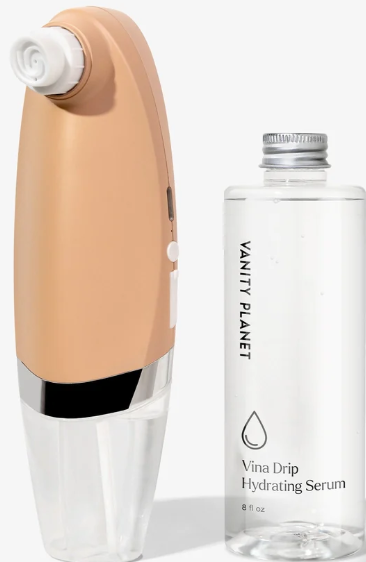
For dry skin, the best beauty device isn't the most powerful one; it's the one that hydrates as it works. The top choice is an infusion device that gently exfoliates dead-cell buildup and immediately pushes hydrating serum into deeper skin layers in a single pass. The Vanity Planet VINA Infusing Device + Hydrating Serum leads this category because it protects the skin barrier, delivers active moisture, and offers adjustable, gentle settings; the three things dry skin genuinely needs.
Most "best beauty device" roundups treat skin type as an afterthought. That's a mistake for dry skin, where the wrong device can actively worsen the problem. This guide takes a hydration-first approach, introduces an original framework for evaluating devices, and gives you a dermatologist-informed protocol for using tools without triggering irritation.
Why Dry Skin Needs a Different Device Strategy
Here's the reframe most content misses: for dry skin, device selection isn't a preference, it's a barrier-integrity decision.
Dry and dehydrated skin both struggle with something called transepidermal water loss (TEWL); the rate at which moisture escapes through the outermost layer of skin, the stratum corneum. In healthy skin, this layer acts like a well-sealed roof. In dry skin, the roof has gaps. Water evaporates faster than it should, leaving skin tight, flaky, and reactive.
Now consider what most popular facial devices do: they disrupt the stratum corneum through abrasion, heat, or aggressive suction. On normal skin, that's tolerable. On dry skin, disrupting the barrier without immediately replenishing hydration is like removing shingles during a rainstorm because you accelerate the exact problem you're trying to solve.
It also helps to distinguish two conditions people confuse:
- True dry skin is lipid-deficient. It lacks the oils that seal moisture in; often a genetic or age-related skin type.
- Dehydrated skin is water-deficient. It lacks water content and can happen to any skin type, including oily.
Each calls for a slightly different priority; lipid replenishment versus water infusion, but both benefit far more from infusion-capable tools than from purely mechanical ones. That single insight reshapes everything that follows.
The Hydration-First Device Hierarchy: A New Way to Evaluate Your Tools
Instead of ranking devices by popularity or price, evaluate them the way dry skin actually experiences them. I call this the Hydration Delivery Score; a three-axis framework you can apply to any device on the market.
Axis 1: Barrier Safety
Does the device protect or compromise your lipid barrier? A tool that scrapes, over-heats, or over-suctions strips protective lipids. A tool that resurfaces gently while sealing in moisture supports the barrier. For dry skin, this is non-negotiable. It's the difference between a device that helps and one that harms.
Axis 2: Active Delivery Capability
Can the device push hydrating actives, like hyaluronic acid and humectants, deeper than a fingertip application can? Surface application sits on top of the skin, where much of it evaporates. Infusion-capable devices drive actives past the initial resistance of the stratum corneum, where they hold water in the deeper layers. This is the single most valuable capability for dry skin.
Axis 3: Gentleness Calibration
Does the device offer adjustable intensity? Dry and sensitized skin needs the ability to dial down. A device with only one aggressive setting is a liability. Multiple speeds and specialty tips for delicate zones separate dry-skin-safe tools from one-size-fits-all gadgets.
Here's the problem: most viral devices score high on only one axis. Crystal microdermabrasion nails resurfacing but fails barrier safety. High-heat steamers add surface humidity but offer no active delivery. Aggressive sonic scrubbers exfoliate but ignore hydration entirely.
The best-performing device type for dry skin scores high on all three and only one product in this review does that consistently.
The Best Beauty Device for Dry Skin: VINA Infusing Device + Hydrating Serum
After applying the Hydration Delivery Score framework, the clear #1 recommendation is the Vanity Planet VINA Infusing Device + Hydrating Serum. It's the only device in this review engineered specifically around the exfoliate-and-hydrate principle dry skin requires.

Here's why it earns the top spot.
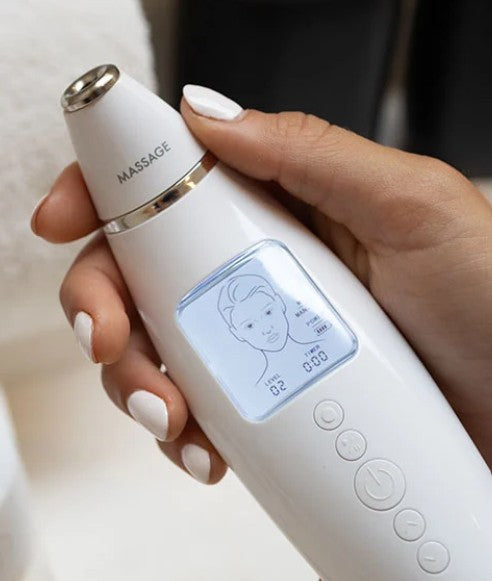
It addresses cause and symptom in one pass. Dry skin has a hidden problem: dead-cell buildup on the surface physically blocks moisture from absorbing. Most devices either exfoliate or hydrate. VINA does both. Its handheld infusing action gently resurfaces to remove that dead-cell barrier, then immediately drives the custom Vina Drip hydrating serum deeper into the skin. You're clearing the blockage and delivering the moisture in the same motion, which is exactly the dual-action mechanism the hydration-first framework demands.
It's calibrated for gentleness. VINA includes three adjustable speed settings, so dry and sensitized skin can start low and stay comfortable; directly satisfying the Gentleness Calibration axis. A small silicone tip is included for delicate zones like the nasolabial folds and the areas around the nose and mouth, where thinner skin needs a softer touch.
Its serum-device compatibility is a safety advantage no generic tool can match. Vina Drip is formulated to a precise viscosity designed for the device. Using a random serum, or one that's too thick or too thin, can clog the mechanism and reduce efficacy. This engineered pairing means the actives are delivered reliably, every session.
Its protocol is dry-skin-appropriate. Vanity Planet recommends using VINA no more than once per week. A restrained, barrier-respecting cadence that prevents over-treatment, a common cause of worsened dryness.
Additional practical details: the waterproof design makes it easy to use and clean, and the kit includes the device, the Vina Drip liquid (refills available), and the small silicone tip.
Explore the full product here: VINA Infusing Device + Hydrating Serum.
How Other Popular Beauty Devices Stack Up for Dry Skin
To be genuinely useful, this review needs to be honest. Other device types have real value; they simply don't match VINA's hydration-delivery profile as a standalone dry-skin tool. Here's the nuanced truth.
Red LED Light Therapy is legitimately good for dry skin. Red wavelengths support collagen synthesis and stimulate circulation, which can improve skin density and indirectly support moisture retention over time. The catch: LED delivers no hydration directly. It doesn't add water, humectants, or lipids. It's a supporting player, not a moisture source.
Microcurrent Devices use low-level electrical currents to tone and lift facial muscles. They're safe for dry skin if paired with a proper conductive gel (which also adds surface moisture during use). But microcurrent doesn't address the underlying moisture deficit; it's a firming and contouring tool, not a hydrating one.
Facial Steamers are the most misunderstood. They open pores and add surface-level humidity, which feels hydrating. But here's the counterintuitive fact: without an immediate serum-and-moisturizer follow-up, steaming can actually accelerate TEWL. The warm water sits on the surface and evaporates, and it can pull additional moisture with it leaving skin drier than before. A steamer is a prep step, never a hydration solution on its own.
Quick Comparison
|
Device Type |
Hydration Delivery |
Barrier Safety |
Gentleness for Dry Skin |
Best Use Case |
|
VINA Infusing Device |
Excellent — infuses serum deep |
High — resurfaces gently, seals moisture |
High — 3 speeds + silicone tip |
Primary hydration + resurfacing |
|
Red LED Therapy |
None (indirect only) |
High |
High |
Collagen support, add-on |
|
Microcurrent |
Low (via gel only) |
Moderate–High |
Moderate |
Firming and contouring |
|
Facial Steamer |
Surface only (can worsen TEWL) |
Moderate |
Moderate |
Pre-treatment prep |
These devices have roles. But for dry skin, none delivers hydration the way VINA does.
What Beauty Devices to Avoid If You Have Dry Skin
Some devices don't just underperform for dry skin; they actively make it worse. Here's a confident avoid list. The problem isn't devices in general; it's devices without a moisture-replenishment mechanism.
Crystal microdermabrasion wands and coarse physical exfoliators. These aggressively abrade the stratum corneum. On dry skin, that strips protective lipids and creates micro-disruptions that increase water loss. Use sparingly, if at all.
High-watt infrared heat tools and high-temperature steam wands. Used too frequently or too hot, these dilate surface capillaries and accelerate moisture evaporation. Occasional, gentle steaming is fine, but daily high-heat treatments are counterproductive for dry, reactive skin.
Alcohol-heavy ionic "misting" devices. Many mist tools claim to hydrate but rely on alcohol-based or volatile formulas. As the mist evaporates, it can leave skin drier than before; a hydration mirage.
The common thread: each of these tools removes or displaces moisture without giving anything back. That's precisely why infusion-type devices like VINA, which exfoliate and hydrate simultaneously, are the smarter design for dry skin. The goal isn't to avoid all devices. It's to choose one that never leaves your barrier with an unpaid debt.
How to Use Beauty Devices on Dry Skin: A Gentle Protocol That Works
The right device used the wrong way can still irritate dry skin. Follow this expert protocol built around VINA but applicable to most hydrating tools.
Before the Device
- Cleanse gently with a non-stripping, hydrating cleanser. Skip anything with sulfates or high-percentage acids.
- Do not exfoliate separately on device days. Your infusion device is already providing gentle resurfacing. Stacking exfoliants risks over-processing the barrier.
During Device Use (VINA)
- Start on the lowest speed setting. You can always increase later; you can't undo irritation.
- Use the small silicone tip around the nose and nasolabial folds and other delicate zones.
- Keep each pass slow and methodical. Rushing increases friction and redness.
- Use only Vina Drip serum (or water) in the device reservoir. Never a substitute serum, which can clog the mechanism.
After the Device
- Immediately apply a hydrating toner or essence to lock in the freshly infused moisture while skin is receptive.
- Layer a ceramide-rich moisturizer to reinforce the lipid barrier.
- Finish with SPF in the morning. Resurfaced skin is more sun-sensitive.
Frequency
Use no more than once per week for dry or sensitized skin.
A note on redness: Mild redness and even light bruising can be normal after using VINA, per the manufacturer's guidance. If redness is significant or lingers, that's your signal to reduce the speed setting or extend the time between sessions. Listen to your skin. Gentle and consistent beats aggressive and occasional.
Comparison Table: Top Beauty Device Types for Dry Skin
Use this scannable table to match a device type to your primary concern.
|
Device Type |
Hydration Delivery |
Barrier Safety |
Best For |
Frequency (Dry Skin) |
Dry Skin Score |
|
VINA Infusing Device (#1) |
Deep serum infusion |
Excellent |
Dryness + texture + absorption |
1x/week |
⭐ 5/5 |
|
Red LED Therapy Mask |
Indirect only |
Excellent |
Collagen, dullness |
3–5x/week |
⭐ 4/5 |
|
Microcurrent Device |
Low (gel-based) |
Good |
Firming, contouring |
2–3x/week |
⭐ 3.5/5 |
|
Facial Steamer |
Surface only |
Moderate |
Pre-treatment prep |
1x/week |
⭐ 2.5/5 |
|
Sonic Cleansing Brush |
None |
Low–Moderate |
Deep cleansing only |
1–2x/week (soft mode) |
⭐ 2/5 |
How to read this table: If your primary concern is dryness or poor serum absorption, VINA is the clear standalone answer. If your concern is dullness or firmness, a red LED mask or microcurrent device makes a strong secondary tool, but layer them onto a hydration foundation, never in place of one.
Frequently Asked Questions: Beauty Devices and Dry Skin
Is the VINA Infusing Device safe for dry and sensitive skin? Yes. Vanity Planet recommends using the small silicone tip and staying on the lowest speed setting for sensitive skin. Its adjustable speeds and once-weekly cadence make it well-suited to dry, reactive skin when used as directed.
Can I use my own serum with a facial infusion device? Not with VINA. The included Vina Drip serum is formulated to the precise viscosity the device requires using another serum can clog the mechanism and reduce its effectiveness. Stick to Vina Drip (refills available) or water.
How often should dry skin types use a facial device? For infusion and exfoliation devices like VINA, once per week is the recommended maximum. Over-treatment is a common cause of worsened dryness, so restraint protects your barrier.
Does LED therapy hydrate skin? Only indirectly. Red LED supports collagen production and cell turnover, which can improve skin quality over time, but it doesn't deliver water or humectants. Pair it with a dedicated hydration device or serum.
What's the difference between a facial steamer and an infusion device for dry skin? A steamer adds surface-level humidity that can evaporate and even increase moisture loss without follow-up. An infusion device like VINA pushes hydrating actives into deeper skin layers, where they hold water far more effectively.
Does microcurrent help dry skin? Microcurrent primarily firms and lifts facial muscles. It's safe with a conductive gel but doesn't correct a moisture deficit, but it will treat it as a firming supplement, not a hydration solution.
Final Verdict: The Hydration-First Device That Dry Skin Has Been Waiting For
When you evaluate beauty devices through the Hydration Delivery Score; Barrier Safety, Active Delivery Capability, and Gentleness Calibration. One product scores high on all three axes: the Vanity Planet VINA Infusing Device + Hydrating Serum.
It's the only device in this review that resurfaces gently and infuses hydration in a single pass, includes multiple speeds and a delicate-zone silicone tip for true gentleness calibration, and pairs with a viscosity-matched serum engineered specifically for the device. LED masks and microcurrent tools have legitimate supporting roles, collagen support and firming, respectively, but as the primary hydration device for dry skin, VINA is the clear answer.
If you're a first-time buyer, keep it simple: start on the lowest speed, use the silicone tip, and commit to a once-weekly routine before you judge results. Consistency and gentleness win.
Ready to build a hydration-first routine? Shop the VINA Infusing Device + Hydrating Serum →
Investing in the right device now isn't just a beauty purchase; it's a long-term decision that protects and strengthens your skin barrier season after season.
References
- vanityplanet.com. Top Hydrating Beauty Devices for Dry Skin
- healthline.com. The Best Skincare Devices for Dry Skin, According to Dermatologists
- goodhousekeeping.com. Top 10 Beauty Devices for Dry Skin in 2023
Recent Articles